Tabletop
Specialist Simulators: The Logic of Discovery

Navigating the technical friction of 19th-century computing, radio astronomy, and the psychoanalytic process as high-fidelity board systems.
Similar to how it’s common for a bunch of movies with similar premises to come out around the same time (think Deep Impact and Armageddon or A Bug’s Life and Antz), we sometimes see similar patterns in the board game industry. There are very logical ones, like the rush of Mars-related games after the success of the movie The Martian (2015) and the release of Terraforming Mars (FryxGames 2016). But then some things seem to happen on their own.
In recent years, we’ve seen a lot of games with very heavy academic and/or historical theming. We’ve yet to get a chance to try Darwin’s Journey (ThunderGrpyh Games 2023) or First in Flight (Artana 2023), but there are a few games along these lines that we have explored. And I have to admit, many of them provide a very unique sense of satisfaction in terms of really bringing the stories and journeys of these historical academic figures to life through game mechanics.
I’ve talked about SETI (Czech Games Edition 2024) in two different articles already - once as part of my Project Hail Mary game night and the other because it uses ReWood as part of a larger shift in more sustainable board game production. And here I am talking about it again…because it’s such a good game. It’s probably the least truly “academic” I’ll cover today, but it gets pretty close, so here we are. And there’s a lot of real-world science woven into every aspect of the game.
SETI is a very real organization, and this game does its best to help players learn more about the different avenues people are following in the hopes of finding evidence of alien life. The abstraction of these efforts into the three forms of alien traces is pretty smart, not just in terms of how it all comes together in terms of game mechanics, but also in how it ties to real-world science.
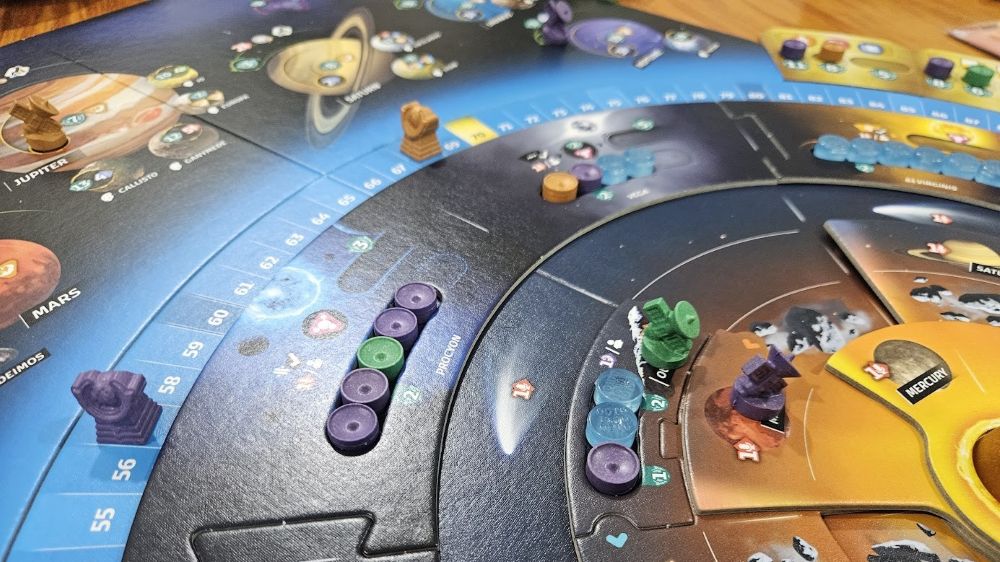
So the simulation aspect has us leveraging radio telescopes to find data signals in far-off stars and feeding that data into supercomputers in the hope of discovering patterns and idiosyncrasies. There’s a whole other aspect of the game tied to launching probes, having them navigate around the solar system, and deciding if they’ll serve you better as orbiters or landers. And this is using a board game that literally rotates and orbits, creating a shifting game environment that approximates our galaxy. And while there is a heck of a lot more to how real-life SETI is actually trying to find alien life in the universe, you have to appreciate that the game condenses a lot of them into 3 main parts of the game and throws in a lot of informative tidbits on cards as well.
This is the real inspiration for this article since we finally got it to the table just last weekend. Ada’s Dream (Alley Cat Games 2025) is the heaviest release we’ve seen from them since Autobahn (Alley Cat Games 2022), and this one feels a lot more ambitious. The likes of Galactic Cruise (Kinson Key Games 2025) set out to make a heavy Euro game that feels like a Vital Lacerda game. But Ada’s Dream feels like a very original approach and one that really celebrates its core theme, exploring a reality where Ada Lovelace gets to create the computing engine of her dreams.
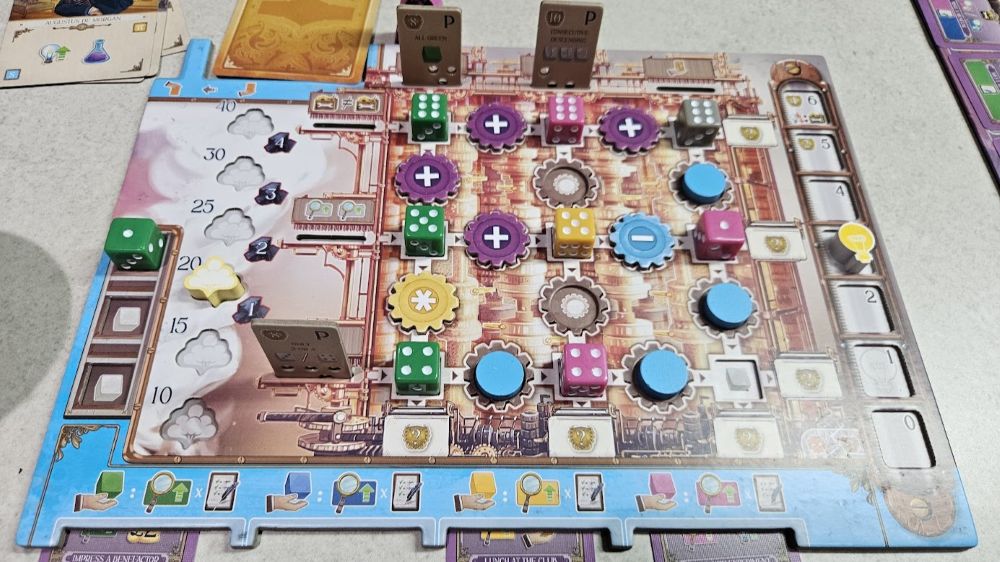
The game centers around the Mill, which is the main area of each player's board where players will slot their dice, add operations gears, insert punch cards, and end with their own little computer. The exercise of putting program cards and gears already feels thematic enough, but the fact that you’ll actually do math with completed lines (equations) to determine scoring is one of the nerdiest things I’ve had to do in a while.
There’s a lot going on in this game, and each aspect tries to capture different aspects of the period that were important to these early computer scientists (for lack of a better term). And that’s a lot of good theming, but the full sense of simulation doesn’t get better than in the Mill. And maybe the novelty of the painted book tokens.
I had never heard of Unconscious Mind (Fantasia Games 2024) until my partner had secured a copy, and it arrived on our doorstep. I was only familiar with the beautiful art associated with the game (and part of many a social media ad while the game was on Kickstarter). But once he started to explain all the complex systems involved and how curing patients is just one small aspect of the game, then I fully came to appreciate why he had been so determined to add this to our collection.

For a game about helping people with mental disorders, the visual direction was very smart indeed. From the Dixit-style cards used to represent what patients are feeling to the acetate Grief Layer cards, the game is striking and certainly dream-like. And I think that does a lot to help players feel fully immersed in the themes of the game. And don’t get me started on the brain/mind-themed tracker for your “resources” in the game that is particularly evocative.
Then you have the unusual inkpot rondel on your player board that stresses the path to helping your patients in a cyclical process. It nicely captures how players need to go over their notebook (player board) over and over again until they come to a breakthrough with their patients. You venture out and meet with others to gain new insights that are captured as new notebook pages to add to your board, which further your engine.
A few honorable mentions for games that certainly have very strong simulationist aspects to how the mechanics are brought together, although they may not feel as strictly “academic” as is the focus of this article.