
P.I.
Official Description:
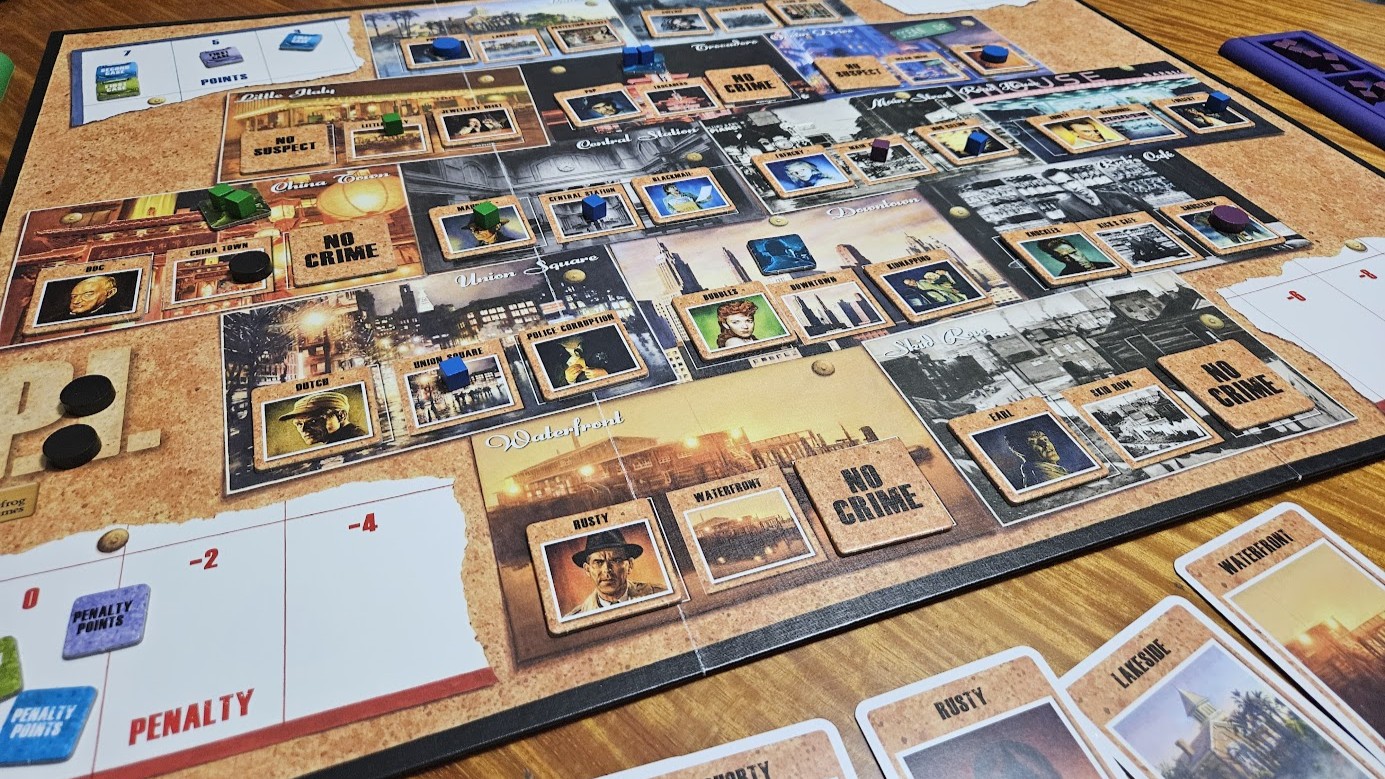
P.I. is a pure deduction game in which players compete over three consecutive mini-games to determine who is the most skilled at solving cases. Each player takes on the role of a private investigator, attempting to solve a crime by identifying the suspect, the crime committed, and the location where it took place. The game is set in a noir-inspired city, with a modular board that changes each game, providing a fresh challenge every time.
During each round, players gather clues by investigating locations, questioning suspects, and analyzing evidence. The game uses a system of tokens and cards to represent the various elements of the case, and players must use logic and deduction to piece together the correct solution. Points are awarded based on how quickly and accurately players solve their cases, with the overall winner being the player with the highest score after three rounds.
P.I. emphasizes careful deduction and strategic thinking, offering a streamlined experience that rewards players who can interpret clues efficiently. The game is designed for those who enjoy classic deduction mechanics, providing a competitive yet accessible environment for both new and experienced players.
Martin Wallace’s P.I. stands as a rare breed among deduction games, sidestepping the classic single-elimination pitfall of Clue by structuring play around three consecutive cases and a rotating solution hand-off. Set in a stylized noir city, the modular board and shifting case elements keep each session unpredictable, rewarding players who thrive on logical rigor and pattern recognition. Its significant long-term shelf retention is no accident—years of managing tables have shown that P.I. consistently delivers a high operational reliability for groups seeking a cerebral, competitive puzzle with real staying power.
Physically, P.I. is a collector’s target: the original edition is tough to source and demands a full main-event setup window, with tokens and cards for each case element and a procedural teach that can’t be rushed. Expect a 20+ minute prep before the first clue is even dropped, making it best suited as the anchor game for a focused deduction night rather than a quick filler. For those who want the experience without the setup, the Board Game Arena implementation is a clean alternative, but the tactile satisfaction of the physical edition is hard to replicate.
From a teaching perspective, P.I. is a procedural system that rewards a methodical approach. The circular puzzle hand-off—where each player manages a neighbor’s hidden solution—requires clear explanation and a steady hand at the rules, especially for first-timers. Once underway, the game’s competitive structure keeps everyone engaged, with the mental friction centered on deduction, inference, and efficient clue management. The room’s energy stays sharp and focused, as players are constantly parsing new information and recalibrating their theories. The skill dividend here is substantial: players leave with sharpened logic, improved information tracking, and a taste for high-stakes deduction that few other titles sustain over repeated sessions.
Category
Thematic & Narrative
My score
8
Our Total Plays
7
Last PLayed
02 Jun 24
🏛️ Legacy
Player Count
2-5
Playtime
60 mins
Proficiency Perks
Systems & Logic
🟢 PLAY NOW
Play on BGA
Check Amazon
As an Amazon Associate, I earn from qualifying purchases.
← ALL BOARD GAMe REVIEWS