
Chronicles of Crime
Official Description:
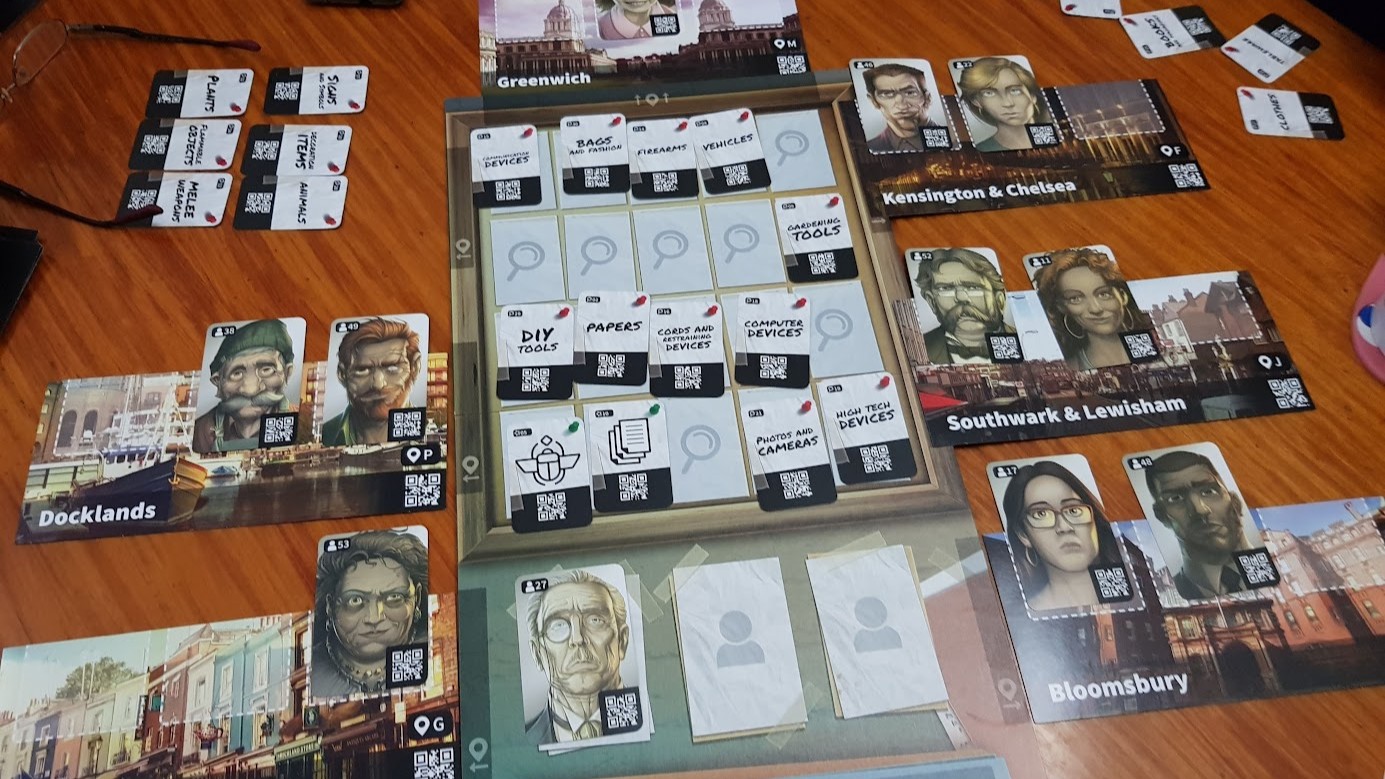
Chronicles of Crime is a cooperative game of crime investigation that blends board gaming, an app, and a touch of virtual reality. Players take on the roles of investigators working together to solve various criminal cases. The game utilizes physical components such as locations, characters, and items, which are integrated with a digital app that drives the narrative and manages clues, evidence, and story progression.
Players scan QR codes on the game components to interact with suspects, examine evidence, and visit locations. The app responds dynamically to player choices, creating a branching narrative and allowing for a wide variety of cases and outcomes. Some scenarios also incorporate virtual reality elements, where players use VR glasses to search for clues in immersive crime scenes.
Chronicles of Crime offers a unique, replayable experience by combining traditional board game mechanics with modern technology. Each case presents new challenges and mysteries, encouraging teamwork, deduction, and critical thinking as players work to uncover the truth behind each crime.
Chronicles of Crime stands as a modern hybrid, merging tactile components with a digital backbone to deliver a procedural detective experience. Its narrative lineage is rooted in the evolution of cooperative deduction, but the app-driven structure and QR-coded interactions push it into contemporary territory—players are not just solving crimes, but actively navigating a branching, tech-mediated story. After years of managing tables, its consistent mechanical performance and replayable casework have earned it solid table-time value, justifying its continued presence even as newer deduction systems emerge. The legacy status is well-earned: it remains a reliable anchor for groups seeking a collaborative, story-rich session that leverages both analog and digital strengths.
From a logistics standpoint, Chronicles of Crime is a main event title, not a filler. Setup demands attention: every session requires sorting physical components and ensuring a compatible device is charged and ready for active scanning. The QR-coded design means every card and location must be accessible and organized, and the 90-minute session time is rarely negotiable. This is not a game to drop in between lighter fare; it commands the table and the group's focus for the evening. The digital integration is seamless when it works, but any technical hiccup—device issues, app updates—can stall momentum, so redundancy planning is advised for hosts.
Teaching Chronicles of Crime is a procedural affair: expect a 20-minute orientation, especially for new players unfamiliar with the scan-and-interact loop. The collaborative structure means the group wins or loses together, but the system’s mental friction is in adapting to the app’s logic—players must shift from traditional clue-hunting to keyword-driven investigation. The skill dividend is clear: teams sharpen their deductive reasoning and communication, learning to parse narrative cues and manage shared information efficiently. The interaction level keeps the room engaged, with everyone invested in piecing together the story, but the facilitator cannot fully step away—guidance is needed to keep the investigation on track and ensure the digital elements enhance, rather than disrupt, the flow.
Category
Thematic & Narrative
My score
7
Our Total Plays
4
Last PLayed
20 Nov 21
🏛️ Legacy
Player Count
1-4
Playtime
90 mins
Proficiency Perks
Systems & Logic
Check Amazon
As an Amazon Associate, I earn from qualifying purchases.
← ALL BOARD GAMe REVIEWS