Hamlet: The Village Building Game
Official Description:
Hamlet: The Village Building Game is a competitive village-building game where players work together to transform a small hamlet into a bustling town. In British English, a hamlet is defined as a small village without a church, and the central goal of the game is to construct the church, which marks the hamlet's transition into a true village. Players take on the roles of founding families, contributing to the growth and development of the community.
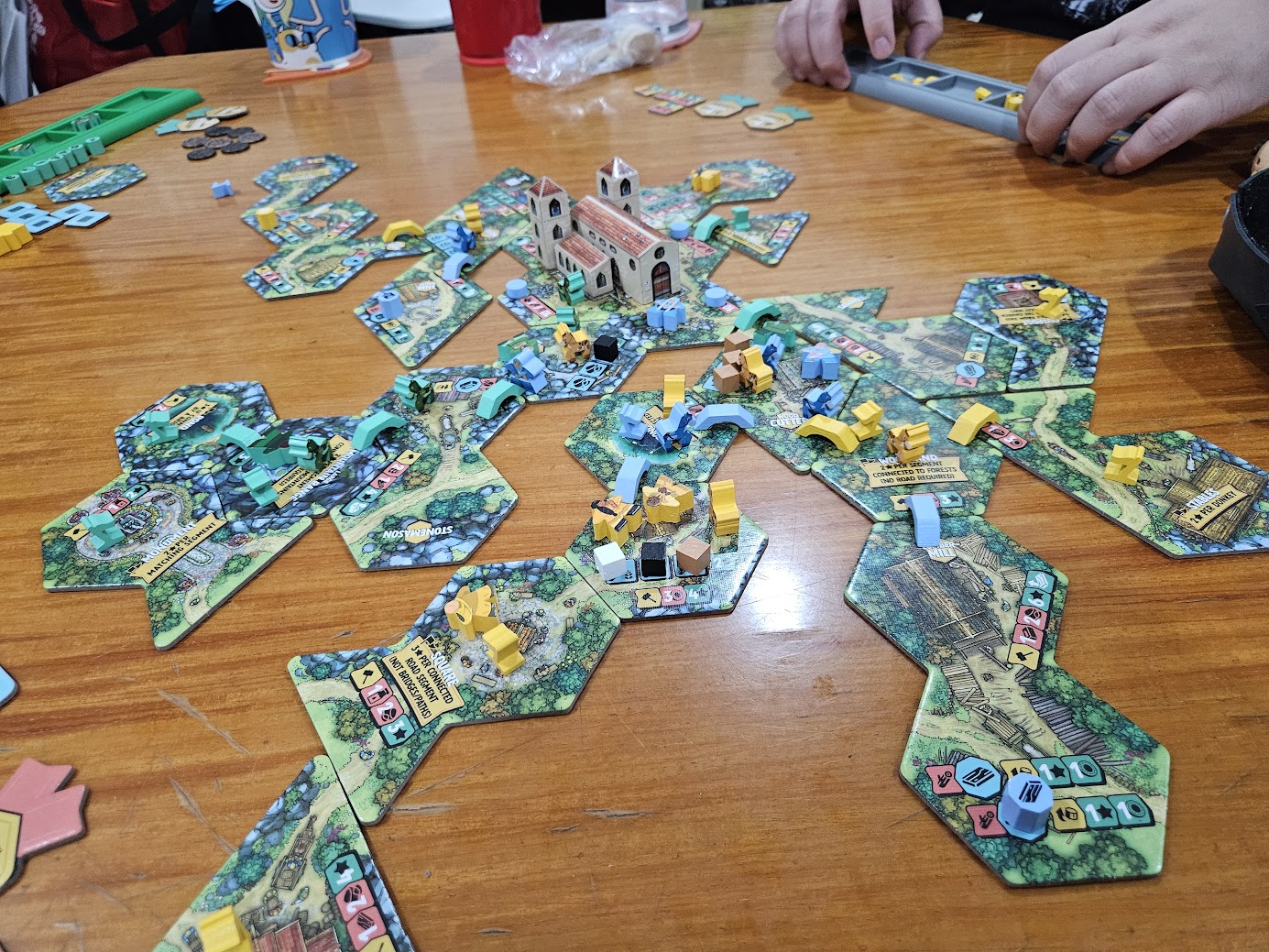
Throughout the game, players build roads, gather and deliver resources, and construct various buildings that expand the hamlet. The village grows organically, with tiles placed in a freeform manner, resulting in a unique layout each game. Shared resources and infrastructure mean that players must carefully plan their actions, balancing cooperation and competition as they strive to earn the most victory points.
The game emphasizes strategic planning, resource management, and spatial organization. As the hamlet expands and the church nears completion, players must adapt their strategies to changing circumstances and opportunities, making each playthrough a distinct and engaging experience.
Hamlet: The Village Building Game operates in the tradition of modular, competitive tile-layers, but distinguishes itself with a shared-resource economy and a networked delivery system that demands constant recalibration. The core tension comes from the way players must leverage communal infrastructure—roads, buildings, and the so-called “donkey networks”—to access and deliver resources, all while jockeying for position in a landscape that evolves with every tile placement. This creates a persistent mental audit of spatial options and timing, rewarding those who can anticipate both their own needs and the likely moves of others. For a collection manager, its high operational reliability is clear: the game’s blend of open-ended growth and tight resource contention ensures significant long-term shelf retention, especially for groups that appreciate a system where every decision ripples through the table. Its current status as a new arrival means it’s still being stress-tested for group fit, but the early signs point to a title with staying power.
From a logistics standpoint, Hamlet sits firmly in the main-event slot for any session. The box contents are well-contained, with a basic cardboard organizer that just manages the base game and expansion, though later printings have improved the clarity of the iconography—a welcome upgrade for teaching and play. Setup and teardown are moderate, fitting the 15-minute prep window, and the organic sprawl of the village means you’ll want a dedicated table for the full 100-minute arc. This isn’t a filler or a warm-up; it’s the kind of system that rewards a focused evening, ideally with a group ready to invest in both the physical and strategic space the game demands.
Teaching Hamlet requires a technical approach. The ruleset is layered, with the donkey network and adjacency rules needing careful explanation to avoid early-game confusion. Once the infrastructure logic clicks, players are challenged by a skill dividend that blends forward planning with spatial visualization—every turn is a negotiation between immediate gain and long-term positioning. The competitive, indirect interaction keeps the room engaged, as every build or delivery can shift the balance of power. For the host, this is not a system you can walk away from after the teach; it benefits from active oversight, especially in early plays, but the payoff is a table that stays mentally engaged and invested throughout.
Category
Tactical & Strategy
My score
8
Our Total Plays
3
Last PLayed
21 Mar 26
🔥 In Rotation
Player Count
1-4
Playtime
100 mins
Proficiency Perks
Strategic Planning
Spatial Reasoning
Check Amazon
As an Amazon Associate, I earn from qualifying purchases.
← ALL BOARD GAMe REVIEWS