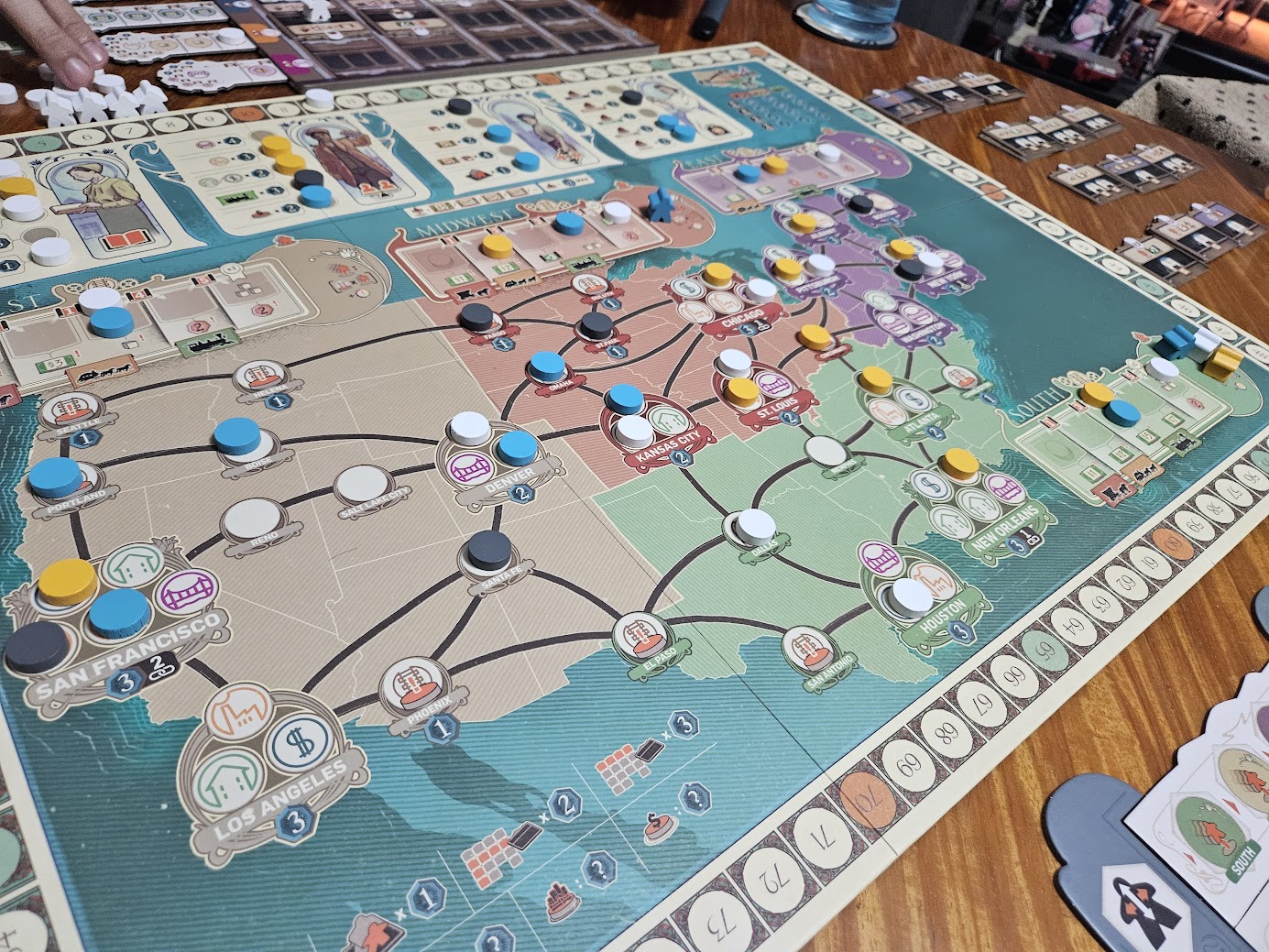

Carnegie
Official Description:
Carnegie was inspired by the life of Andrew Carnegie, who was born in Scotland in 1835 and emigrated to the United States with his parents. He became one of the most influential benefactors and entrepreneurs of his era, contributing to the development of the United States through his investments and philanthropy.
In the game, players compete to become the most influential entrepreneur and benefactor by managing their companies, expanding their businesses, and contributing to the country’s growth. Players will recruit and manage employees, expand their businesses by investing in various projects, and develop their transportation networks across the United States.
Throughout the game, players must make strategic decisions about how to allocate resources, when to invest, and how to balance profit with philanthropy. The player who best manages their company and contributes most significantly to the nation’s development will emerge victorious.
Carnegie operates as a high-interaction economic system, drawing clear inspiration from classic Euro-style network builders while layering in a sharp focus on philanthropic timing and spatial positioning. The action-follow mechanism ensures that every player’s decision reverberates across the table, creating a dense, shifting puzzle where tactical foresight and opportunistic adaptation are constantly in tension. Its significant long-term shelf retention is anchored by the way it rewards both strategic planning and nimble response to opponents’ moves—a hallmark of titles that have survived years of shelf competition. For a veteran curator, Carnegie’s operational reliability and replayable depth justify its continued presence in any serious collection.
From a logistics standpoint, this is a main event title—expect a full evening’s commitment. The O’Toole presentation does heavy lifting, providing visual clarity that supports a complex, multi-layered board state, but setup and teardown are non-trivial. Components are numerous and demand careful organization to maintain flow during play. With a 120-minute session time and a technical teach, this is not a casual filler; it’s best reserved for groups ready to invest in a focused, uninterrupted session.
Teaching Carnegie requires a methodical approach. Scoring triggers and reward eligibility are not immediately intuitive, so a veteran lead is essential to clarify the nuances before the first round. The system’s mental friction is substantial: players must track evolving networks, anticipate rivals’ actions, and optimize both timing and spatial deployment. The competitive, high-interaction environment keeps the table engaged and alert—energy stays high, but the teach demands you remain present to field questions and reinforce key rules. The skill dividend here is real: players leave with sharpened resource allocation instincts and a deeper appreciation for timing in shared-action economies.
Category
Tactical & Strategy
My score
8
Our Total Plays
2
Last PLayed
10 Oct 23
🏛️ Legacy
Player Count
1-4
Playtime
120 mins
Proficiency Perks
Strategic Planning
👑 PREMIUM
Play on BGA
Check Amazon
As an Amazon Associate, I earn from qualifying purchases.
← ALL BOARD GAMe REVIEWS