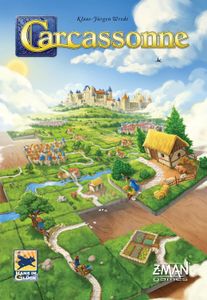
Carcassonne
Official Description:
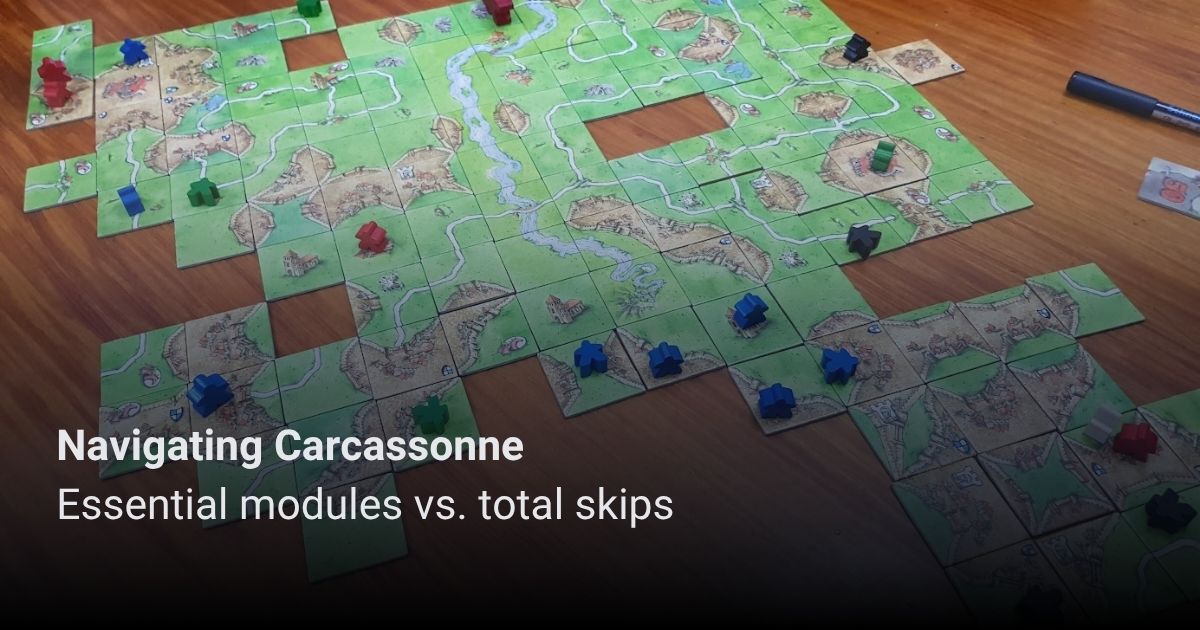
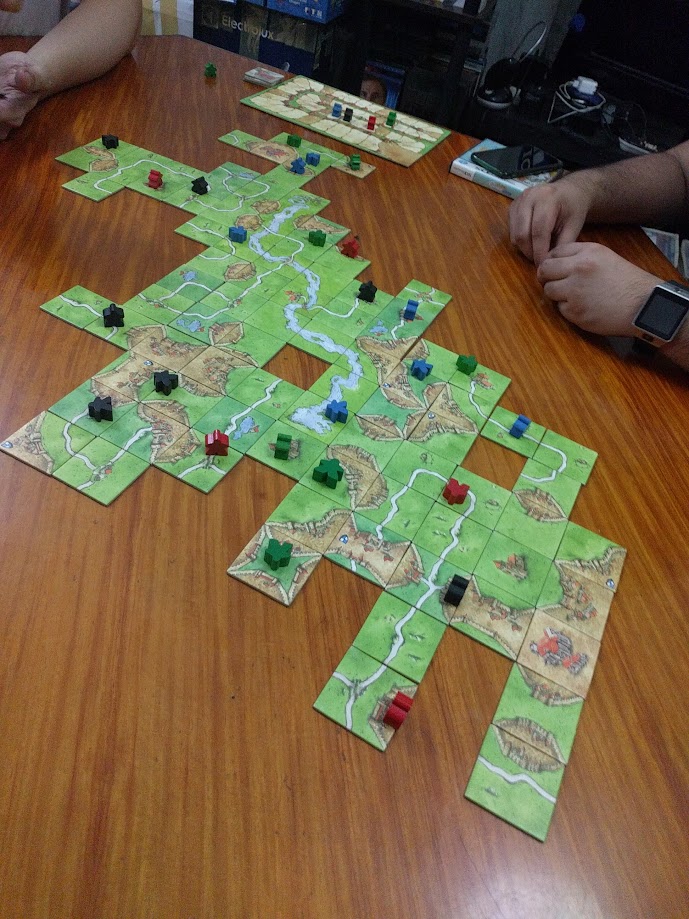
Carcassonne is a tile-placement game in which players draw and place a tile with a piece of southern French landscape on it. The tile might feature a city, a road, a cloister, grassland, or some combination, and it must be placed adjacent to tiles that have already been played, in such a way that cities are connected to cities, roads to roads, and so on. After placing a tile, the player can then decide to place one of their followers, called "meeples," on one of the features on the tile: in the city as a knight, on the road as a robber, in a cloister as a monk, or on the grass as a farmer.
Players score points by completing features: cities, roads, and cloisters are completed when they are fully enclosed, and farmers score points at the end of the game for fields that supply completed cities. The game continues until all tiles have been placed, and the player with the most points wins.
Carcassonne is known for its simple yet deep gameplay, making it accessible to new players while offering strategic depth for experienced gamers. The game has inspired numerous expansions and remains a classic in the modern board gaming hobby.
Carcassonne’s enduring presence in the modern hobby is anchored by its direct, competitive tile-placement and the sharp, incremental tension of its map-building. As a procedural classic, it delivers a top-tier strategic dividend: every tile placement is a micro-decision with long-term implications, and the board’s evolving landscape demands constant recalibration. The system’s high operational reliability is evident in its nearly two decades of shelf retention—few titles maintain this level of table presence and replay value. Its tactical DNA is rooted in the Euro lineage, but the one-tile-at-a-time structure keeps the pace brisk and the mental friction accessible, making it a perennial recommendation for both new and veteran tables.
From a logistics standpoint, Carcassonne is a model of efficiency. The box is compact, with enough room to house a couple of expansions without sacrificing setup speed. Sessions clock in at about 45 minutes, making it a flexible anchor for a game night—substantial enough to serve as a main event, but not so demanding that it derails the evening’s flow. The physical footprint is modest, and the modular nature of the components means teardown is as straightforward as the initial setup. For curators managing a growing collection, it’s a foundational system that scales well and doesn’t require elaborate storage solutions.
Teaching Carcassonne is a procedural exercise: the core rules are approachable, but the nuance—especially around farm scoring and field connectivity—requires a deliberate walkthrough. The game’s competitive structure keeps the table engaged, with indirect blocking and spatial jockeying fueling a steady undercurrent of tension. The board performs a sharp audit of each player’s spatial visualization and forward planning, rewarding those who can anticipate both immediate gains and endgame scoring. Once the basics are established, the system is self-sustaining; a veteran can step away and trust the table to manage itself, while players walk away with a tangible skill dividend in spatial reasoning and adaptive strategy. The interaction level keeps the energy high, ensuring that even quieter groups stay invested from the first tile to the last.
Category
Tactical & Strategy
My score
9
Our Total Plays
39
Last PLayed
31 Jul 26
🚀 High Velocity
Player Count
2-5
Playtime
45 mins
Proficiency Perks
Strategic Planning
Spatial Reasoning
👑 PREMIUM
Play on BGA
Check Amazon
As an Amazon Associate, I earn from qualifying purchases.
← ALL BOARD GAMe REVIEWS