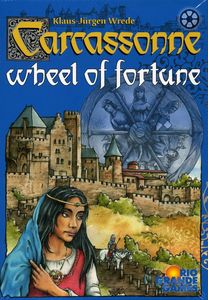
Carcassonne: Wheel of Fortune
Official Description:
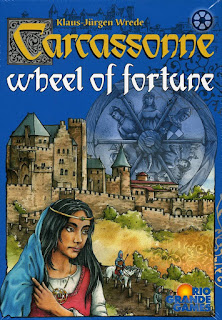
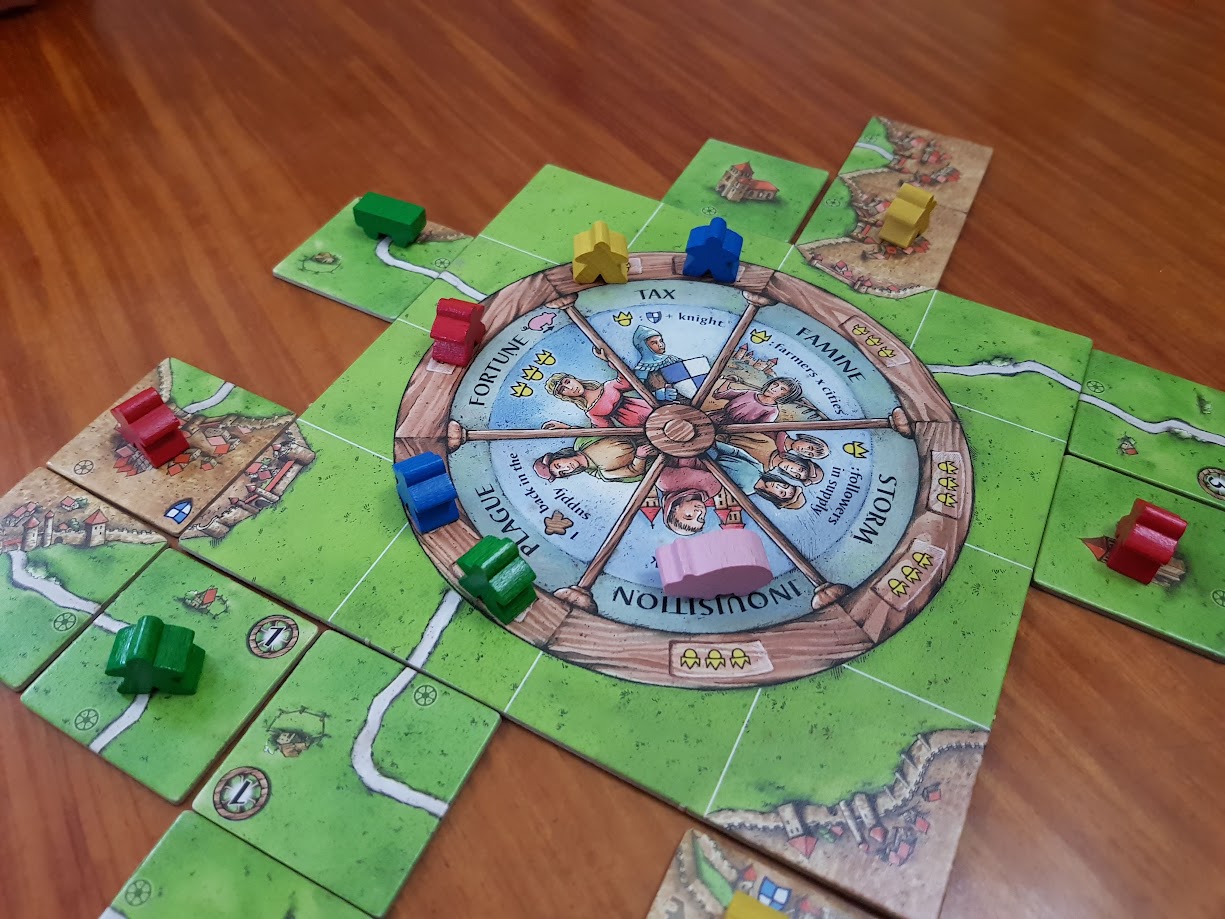
Carcassonne: Wheel of Fortune is both a standalone game and an expansion to the original Carcassonne. It features a large Wheel of Fortune in the center of the board, which introduces new tactical elements and random events that can affect all players. The game includes 72 tiles, most of which are from the original Carcassonne base game, along with a selection from various expansions.
Players take turns drawing and placing tiles to build cities, roads, cloisters, and fields, just as in the classic Carcassonne. However, the Wheel of Fortune adds a new layer of strategy: certain tiles trigger movement on the wheel, which can grant points, remove followers, or introduce other effects. This mechanic adds unpredictability and requires players to adapt their strategies throughout the game.
Carcassonne: Wheel of Fortune can be played as a complete game on its own or combined with other Carcassonne expansions. The addition of the wheel makes for a dynamic experience, offering both familiar gameplay and fresh challenges for new and experienced players alike.
Carcassonne: Wheel of Fortune stands as a robust evolution within the tile-laying lineage, leveraging the familiar city, road, and field construction of its predecessor while injecting a dynamic central mechanism—the Wheel of Fortune. This large starting tile introduces a rotating event system, forcing players to recalibrate their plans as the board state shifts unpredictably. The rondel logic at the heart of the wheel demands a sharper audit of timing and risk, rewarding those who can pivot strategies mid-game. After years of managing tables, I can confirm this title’s high operational reliability: it consistently delivers a top-tier strategic dividend, maintaining significant long-term shelf retention for groups seeking both familiarity and a fresh tactical layer. Its legacy status is well-earned, as it continues to offer meaningful variety and replay value even after repeated sessions.
From a logistics standpoint, Wheel of Fortune is packaged as a standalone box, with a notably large central tile and an extra follower set—making it easy to deploy for both new and returning players. Setup is straightforward, fitting comfortably within a 15-minute prep window, and the session time rarely exceeds half an hour. The box contents are modular enough to serve as a secondary storage solution for expansions, which is a practical bonus for curators managing multiple Carcassonne variants. In a typical game night, this system functions best as a reliable anchor—substantial enough to be a main event for casual groups, or a high-value opener for more seasoned tables.
Teaching Wheel of Fortune requires a procedural approach: the core tile placement is accessible, but the wheel’s event triggers and scoring nuances demand clear, up-front explanation. The mental friction here is moderate; players must track shifting opportunities and anticipate the impact of random events, which sharpens their adaptive planning and spatial visualization. Competitive interaction remains indirect but ever-present, keeping the table engaged and attentive to each move. Once the initial hurdles are cleared, the system allows a veteran host to step back and let the table self-regulate, with the room’s energy sustained by the unpredictable swings and tactical recalibrations the wheel provides.
Category
Tactical & Strategy
My score
9
Our Total Plays
3
Last PLayed
01 May 17
🏛️ Legacy
Player Count
2-5
Playtime
30 mins
Proficiency Perks
Strategic Planning
Spatial Reasoning
Check Amazon
As an Amazon Associate, I earn from qualifying purchases.
← ALL BOARD GAMe REVIEWS