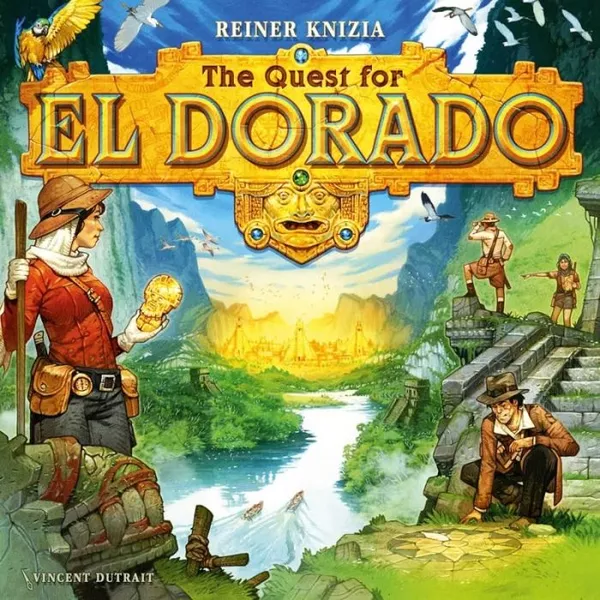
The Quest for El Dorado
Official Description:
In The Quest for El Dorado, players take on the role of expedition leaders racing through the jungles of South America in search of the legendary city of gold. Each player assembles their own team and equips them with the necessary tools, hiring specialists and acquiring useful items along the way. The journey is fraught with dense forests, rivers, and other obstacles, requiring careful planning and strategic use of resources.
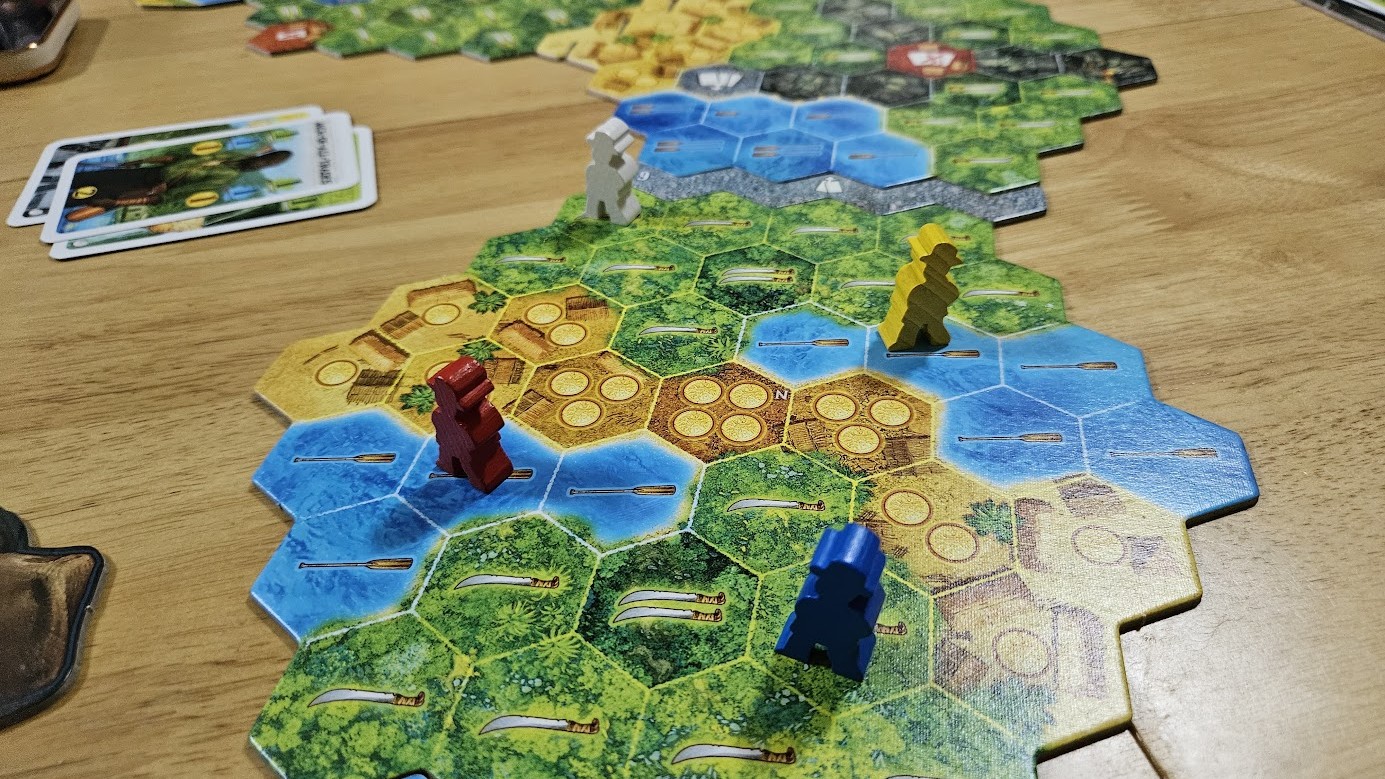
The game utilizes a deck-building mechanism, where players gradually improve their decks by purchasing new cards that provide movement, special abilities, or other advantages. Each turn, players use cards from their hand to advance through the modular board, which can be arranged differently for each game, ensuring high replayability. The challenge lies in optimizing your deck and choosing the best path to outpace your rivals.
Victory goes to the first player to reach the fabled city of El Dorado. The Quest for El Dorado combines tactical decision-making, resource management, and competitive racing, making it a dynamic and engaging adventure for all participants.
As a modular deck-building race, The Quest for El Dorado draws from the lineage of tactical movement games while layering in the evolving engine-building of modern card systems. The modular board ensures each session feels distinct, and the need to optimize card purchases for specific terrain types keeps the mental friction high. Over years of managing tables, its consistent mechanical performance has made it a reliable secondary option—never the flashiest, but always delivering a competitive, replayable experience. Its legacy status is well-earned: it survives shelf competition by offering a dynamic race that rewards both planning and adaptability, with expansion content deepening the challenge for returning groups.
Component-wise, the box is straightforward: a modular board, a healthy stack of cards, and plenty of cardboard pieces. Setup is not instant—expect a solid 20 minutes to get the board arranged and decks sorted, especially if you’re using expansion content. For a 60-minute session, it sits comfortably as a main event for mid-sized groups, especially when you want a session that feels substantial but doesn’t overstay its welcome. The physical footprint is moderate, but the modularity means you’ll need a bit of table space and some patience for initial setup and teardown.
From a teaching perspective, this is a procedural system: expect to spend 15–20 minutes clarifying card interactions and the nuances of terrain movement. The competitive structure keeps the table engaged, but you’ll want to stay close for the first few rounds to ensure players are acquiring the right cards for the right obstacles. The skill dividend here is twofold: players sharpen their ability to plan several turns ahead while also performing a sharp audit of spatial options on the board. The indirect competition—racing rather than direct conflict—keeps the energy high without tipping into chaos, making it a strong fit for groups that enjoy tactical tension without heavy negotiation or confrontation.
Category
Tactical & Strategy
My score
7
Our Total Plays
1
Last PLayed
04 Nov 23
🏛️ Legacy
Player Count
2-4
Playtime
60 mins
Proficiency Perks
Strategic Planning
Spatial Reasoning
Check Amazon
As an Amazon Associate, I earn from qualifying purchases.
← ALL BOARD GAMe REVIEWS