
The Castles of Burgundy
Official Description:
The Castles of Burgundy is set in the Burgundy region of High Medieval France. Each player assumes the role of an aristocrat, initially controlling a small princedom. The objective is to build settlements and powerful castles, practice trade along the river, exploit silver mines, and use the knowledge of travelers. Players use dice to determine their actions, but there are various ways to mitigate luck and optimize their strategies.
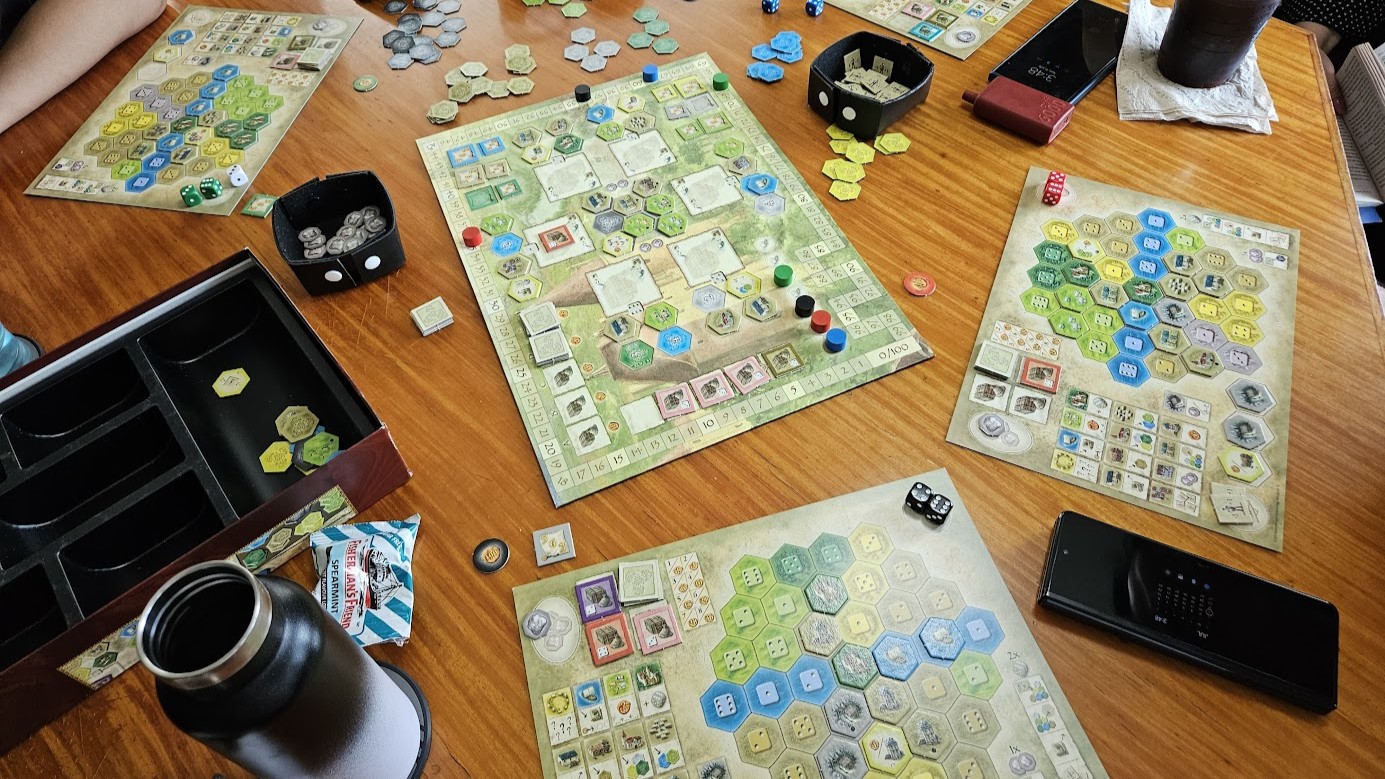
Throughout the game, players acquire hexagonal tiles representing different buildings, animals, knowledge, ships, and mines, which they place on their personal estate boards. The placement of these tiles is crucial, as it can trigger bonuses and scoring opportunities. The game is played over five phases, with each phase consisting of multiple rounds where players roll dice and take actions such as acquiring tiles, placing them, or selling goods.
The Castles of Burgundy is renowned for its deep strategic gameplay, offering a blend of tactical decisions and long-term planning. The modular setup and variety of tiles ensure high replayability, making it a classic in the Eurogame genre.
As a procedural Euro rooted in the tactical tile-layer tradition, this Feld design has maintained consistent mechanical performance over years of managing tables. Its enduring presence is anchored by a blend of dice-driven action selection and a modular estate board that demands careful sequencing. The system’s legacy status is earned: it rewards players who can audit spatial options and plan several turns ahead, but it never fully lets go of its luck-mitigation puzzle. For a collection, it remains a reliable secondary option—never the flashiest, but always delivering a solid table-time value, especially for groups who appreciate a steady, strategic dividend.
Component-wise, the original release’s thin cardboard tiles are serviceable but prone to shifting, so expect some minor table maintenance during play. Setup and teardown are straightforward, fitting comfortably into a 15-minute prep window, but the game’s footprint and tile management mean it’s best positioned as a main event rather than a filler. Ninety minutes is a realistic session length for a full table, and the physical system is robust enough for repeat plays, though not immune to wear. For hosts, it’s a dependable choice when you want a session anchored by thoughtful play rather than spectacle.
From a teaching perspective, the ruleset is procedural—expect a 20-minute teach, with most of that time spent clarifying the turn sequence and the nuances of tile placement. Once underway, the parallel play structure means you can step back and let the table run itself after the first phase. The mental friction here is substantial: players are constantly balancing immediate tactical gains against long-term estate optimization, and the board performs a sharp audit of each player’s spatial visualization. Interaction is indirect, so the room’s energy stays focused and contemplative, making it ideal for groups who prefer measured competition over direct confrontation.
Category
Tactical & Strategy
My score
7
Our Total Plays
4
Last PLayed
06 Sep 23
🏛️ Legacy
Player Count
2-4
Playtime
90 mins
Proficiency Perks
Strategic Planning
Spatial Reasoning
🟢 PLAY NOW
Play on BGA
Check Amazon
As an Amazon Associate, I earn from qualifying purchases.
← ALL BOARD GAMe REVIEWS