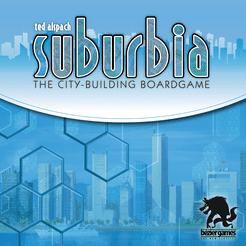
Suburbia
Official Description:
Suburbia is a tile-laying game in which each player aims to build up an economic engine and infrastructure that will be initially self-sufficient and eventually become both profitable and encourage population growth. Players work to develop their own unique borough, adding residential, commercial, civic, and industrial areas, as well as special points of interest that provide benefits and help attract new residents.
As the game progresses, players must balance income and reputation, making strategic decisions about which tiles to purchase and where to place them. Each tile interacts with others in the borough and sometimes with those in opponents’ boroughs, creating a dynamic and evolving cityscape. The goal is to have the largest population by the end of the game, achieved through careful planning and efficient management of resources.
Suburbia challenges players to think ahead, adapt to changing circumstances, and optimize their city’s growth. The interplay of tile effects, economic management, and competition for objectives ensures a deep and engaging experience for all participants.
Suburbia stands as a benchmark in the city-building genre, channeling the spirit of classic tile-placement systems while demanding a sharp audit of each player’s ability to visualize and optimize spatial relationships. Its enduring presence on shelves is no accident—years of managing tables have shown that its economic engine and evolving cityscapes deliver a top-tier strategic dividend. The interplay between adjacency effects and global tile triggers creates a dynamic puzzle that rewards forward planning and adaptability, ensuring significant long-term shelf retention for any serious collection. Suburbia’s procedural depth and tight economic feedback loop have cemented its status as a proven classic, consistently delivering a satisfying mental workout without overstaying its welcome.
Physically, Suburbia is a straightforward affair: the box is utilitarian, with no insert or sorting solution beyond what you provide yourself. Expect to supply baggies to keep the components in order, especially if you want to avoid setup delays. With a 90-minute session time, it’s best positioned as the main event for a focused group—this isn’t a filler or a warm-up. The game’s footprint is manageable, but the tile array and player boards require a bit of table real estate, so plan accordingly. For hosts, the lack of frills means less distraction, but also no shortcuts; setup and teardown are entirely manual.
From a teaching perspective, Suburbia sits firmly in the procedural camp. A clear rules explanation—especially around the distinction between adjacency and global tile effects—is essential to avoid confusion mid-game. Once underway, the parallel play structure means you can step back and let players manage their own boroughs, intervening only for rules clarifications. The system’s mental friction is substantial: players will leave the table with a sharpened sense of spatial optimization and resource sequencing. Interaction is indirect, so the room’s energy is focused and contemplative rather than boisterous, making it ideal for groups who appreciate thoughtful, competitive play without direct confrontation.
Category
Tactical & Strategy
My score
10
Our Total Plays
44
Last PLayed
28 May 23
🏛️ Legacy
Player Count
1-4
Playtime
90 mins
Proficiency Perks
Strategic Planning
Spatial Reasoning
Check Amazon
As an Amazon Associate, I earn from qualifying purchases.
← ALL BOARD GAMe REVIEWS