Streets
Official Description:
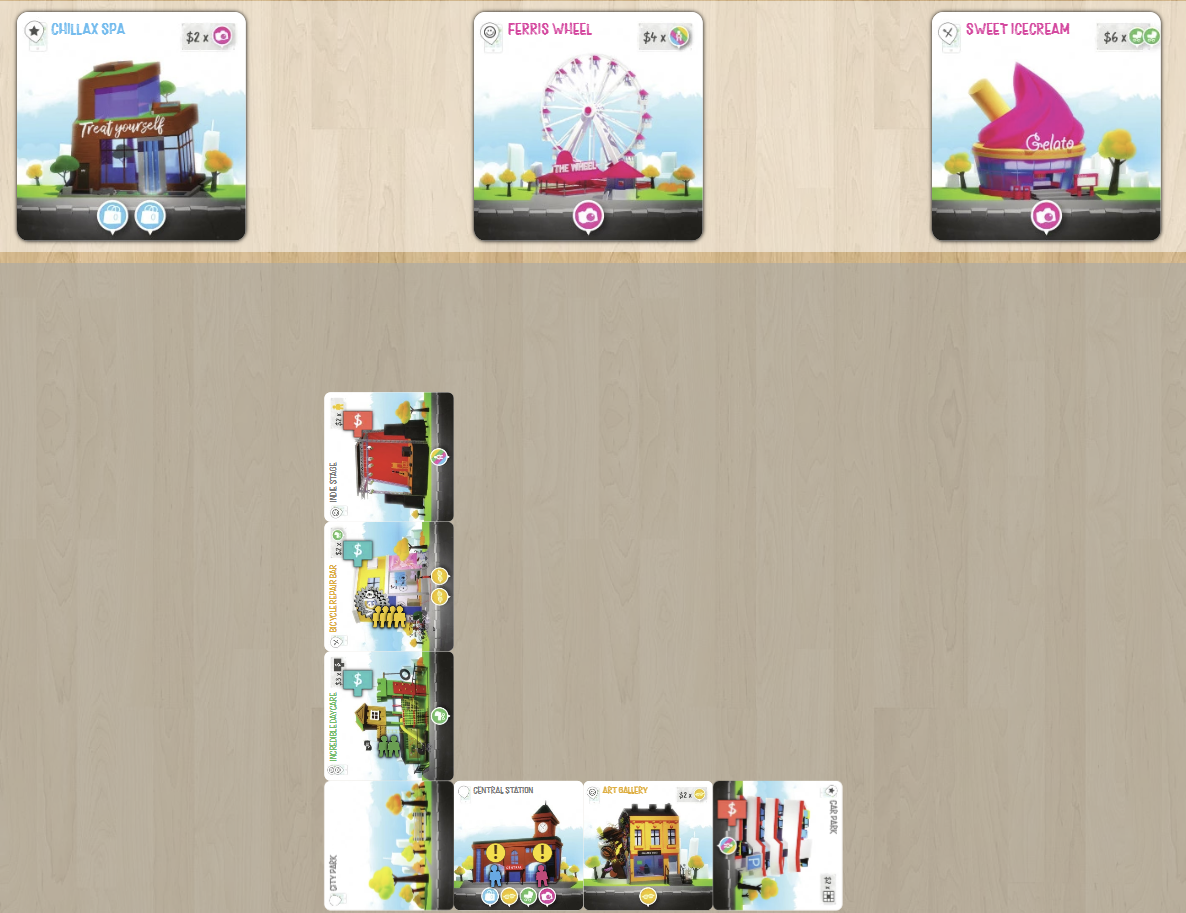
Streets is a tile-laying game for 1-5 players in which players build a city together by placing building tiles to create streets. Each building has its own unique way of generating money for the owner, usually based on the people present on the street. As new buildings are added, streets become longer and more valuable, attracting different types of people who move between streets as they are scored. The game features a dynamic cityscape, with streets being completed and scored throughout the game, rather than only at the end.
Players take turns placing building tiles, adding their own ownership markers, and populating the city with wooden meeples representing different types of people, such as tourists, hipsters, shoppers, and parents. Each type of person is attracted to specific buildings, and their presence increases the value of the street. When a street is completed, it is scored, and the owner of each building receives money based on the building’s scoring condition and the people present. After scoring, people move to adjacent streets, creating opportunities for chain reactions and strategic planning.
The game ends when all building tiles have been placed and the final streets are scored. The player with the most money at the end of the game is the winner. Streets offers a blend of tactical tile placement, area control, and resource management, with a focus on timing and maximizing the value of each street as the city evolves.
Within the context of modular tile-layers, Streets delivers a city-building puzzle where every tile placement is a calculated investment. The system’s tactical core is rooted in timing—when to close a street, how to leverage shifting patron types, and how to maximize payouts as the city morphs. While the spatial design remains engaging, the flow of citizen movement can feel less intuitive than earlier tile-layers, introducing a layer of mechanical friction that limits its long-term shelf retention. For a collection with nearly two decades of table management behind it, Streets now serves as a selective deployment—its niche ROI is best appreciated by groups who enjoy dissecting spatial systems rather than those seeking fluid, high-frequency play.
Component-wise, the compact Sinister Fish box is a logistical win, storing the street tiles and wooden meeples efficiently. Setup and teardown are straightforward, fitting comfortably into a 15-minute prep window. With a 60-minute session time, Streets is best positioned as a focused main event for a smaller group, rather than a quick filler or a sprawling anchor for the night. The physical footprint is modest, and the game’s structure keeps downtime manageable, but the shifting patron mechanics require players to stay engaged throughout.
From a teaching perspective, Streets is approachable—most groups are comfortable by the second round, and the ruleset is light enough for a single host to monitor multiple tables. The system’s mental friction comes from visualizing how patron movement and street scoring will cascade, rewarding players who can anticipate spatial shifts and plan accordingly. The competitive interaction is indirect but persistent, keeping the table alert and invested. The energy in the room trends analytical, with players quietly tracking opportunities and timing their moves for maximum effect.
Category
Tactical & Strategy
My score
6
Our Total Plays
2
Last PLayed
25 Jan 24
🏛️ Legacy
Player Count
1-5
Playtime
60 mins
Proficiency Perks
Strategic Planning
Spatial Reasoning
🟢 PLAY NOW
Play on BGA
Check Amazon
As an Amazon Associate, I earn from qualifying purchases.
← ALL BOARD GAMe REVIEWS