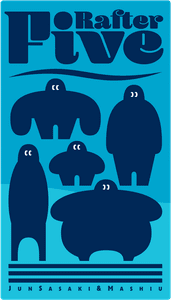
Rafter Five
Official Description:
In Rafter Five, players compete to build the largest raft possible while aiming to be the only one able to board it. The game involves creating a raft from cards piece by piece, using rafters to help balance the build. Players must carefully extend out cardboard planks from a central raft and balance treasure chests against the counterweight of a meeple.
The gameplay centers on dexterity and strategic placement, as each player tries to place all of their treasure onto the raft while also attempting to disrupt their opponents’ efforts. The challenge lies in expanding the raft without causing it to collapse, requiring both skill and tactical thinking.
Rafter Five is designed for 2 to 6 players and offers a blend of balance, competition, and interactive play. The objective is to outmaneuver opponents by constructing a stable raft and successfully loading all your treasures, making it a dynamic and engaging experience for players of all ages.
Rafter Five sits comfortably within the tradition of quick, interactive dexterity games, but its staying power comes from a clever twist: every placement is both a test of balance and a calculated risk against your rivals. The game’s physical spectacle—watching a raft of cards and wooden pieces teeter ever higher—delivers a memorable table presence that’s hard to ignore, especially as players jockey to force each other into mistakes. Its scoring system, which rewards you for triggering your opponents’ collapses, injects a layer of tactical brinkmanship that keeps even seasoned groups engaged. As a result, Rafter Five earns its place as a selective deployment only—its niche ROI is best appreciated by groups who enjoy a blend of laughter and sabotage, rather than those seeking deep strategic arcs. Its legacy status in the collection is a testament to its ability to spark memorable moments, even if it doesn’t see constant rotation.
From a logistics standpoint, Rafter Five is a model of efficient design: the compact box belies the sprawling, three-dimensional structure that emerges on the table. Setup is straightforward, and the game’s footprint expands as the raft grows, making it a visual centerpiece for any session. With a 20-minute playtime, it’s best deployed as a lively interlude between heavier games or as a closer when the group’s energy is high but attention spans are short. The physicality of balancing cards and wooden chests means you’ll want a stable surface and players willing to lean in—literally and figuratively. It’s not a main event, but it reliably fills the gaps with laughter and groans.
Teaching Rafter Five is a low-barrier affair; most groups will be comfortable by the second round, and the ruleset is simple enough that the host can step back and let the chaos unfold. The game’s mental friction comes from the need to visualize spatial relationships and anticipate how each new piece will shift the raft’s balance, rewarding players who can quickly assess risk and opportunity. The competitive dynamic keeps the room lively, as every move has the potential to upend someone’s plans—sometimes literally. Players leave the table with a sharpened sense of spatial awareness and a reminder that sometimes, the best move is the one that leaves your opponent teetering on the edge.
Category
Casual & Filler
My score
6
Our Total Plays
1
Last PLayed
🏛️ Legacy
Player Count
1-6
Playtime
20 mins
Proficiency Perks
Reflex & Speed
Spatial Reasoning
Check Amazon
As an Amazon Associate, I earn from qualifying purchases.
← ALL BOARD GAMe REVIEWS