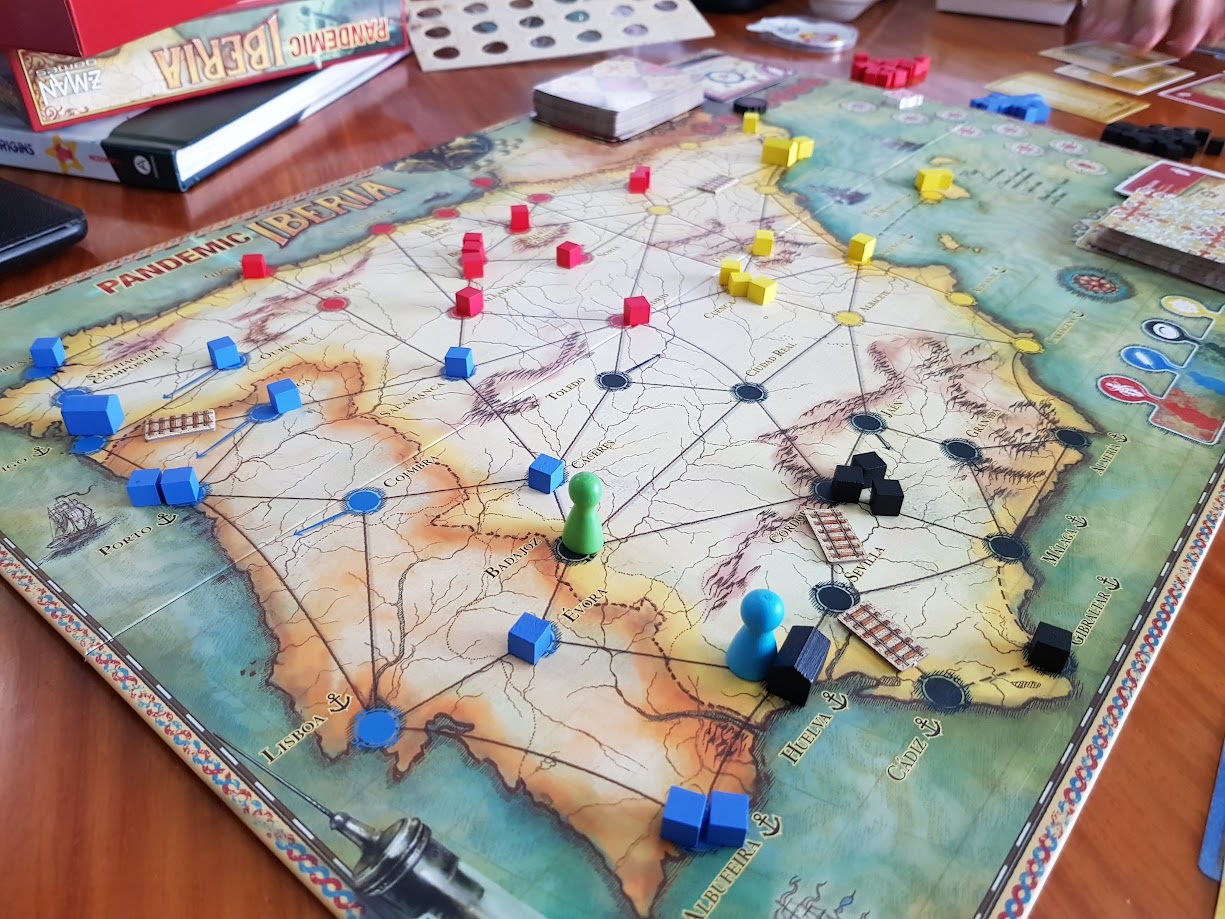

Pandemic: Iberia
Official Description:
Set in 1848, Pandemic: Iberia transports players to the Iberian Peninsula at a time when diseases such as malaria, typhus, yellow fever, and cholera threaten the region. Players assume the roles of historical figures like nurses, railwaymen, rural doctors, and sailors, each with unique abilities to help combat the spread of these diseases. The game challenges players to work cooperatively to research cures and prevent outbreaks, all while navigating the unique geographical and historical context of 19th-century Spain and Portugal.
Unlike the original Pandemic, players in Iberia must also build railways to facilitate travel and the delivery of clean water, reflecting the era's technological limitations and the importance of infrastructure. The diseases cannot be fully eradicated, only contained, which adds a layer of difficulty and historical realism. Players must balance their efforts between treating patients, constructing railways, and purifying water supplies to slow the spread of infection.
Pandemic: Iberia offers a fresh take on the cooperative gameplay of the Pandemic series, integrating historical events and challenges specific to the time period. The game includes additional variants, such as the migration of patients and historical disease challenges, providing increased replayability and depth for players seeking a unique and immersive experience.
Pandemic: Iberia stands apart within the cooperative lineage by embedding players in the logistical and thematic constraints of 19th-century Spain and Portugal. The historical context isn’t just window dressing—diseases can only be contained, not eradicated, and the need to construct railways and purify water introduces a sharper edge to the familiar tension of the series. Progress tracks and period-accurate treatments force a more deliberate approach, rewarding groups that can coordinate under pressure. For a collection with nearly two decades of table management behind it, Iberia’s consistent mechanical performance and solid table-time value justify its continued presence, even if it doesn’t eclipse the original’s shelf dominance.
From a hosting perspective, the game’s standard box and classic wooden cubes keep setup within the 15-minute mark, making it a practical choice for a focused session. The distinct thematic board is visually engaging but never overwhelming, and the physical footprint is manageable for most tables. At 45 minutes per session, Iberia is best positioned as a main event for groups seeking a collaborative challenge with historical flavor, rather than a quick filler or late-night closer.
Teaching Iberia is a procedural affair—expect a 20-minute rules overview, especially for players new to the series or the era-specific mechanics. The collaborative structure means you can guide the first few turns, then step back as the group internalizes the interplay between treating diseases, building infrastructure, and managing limited resources. The system’s mental friction comes from balancing immediate threats with long-term planning, and players leave the table with a sharpened sense of group coordination and adaptive problem-solving. The pure cooperative dynamic keeps the room engaged and focused, with tension rising as the board state evolves.
Category
Tactical & Strategy
My score
7
Our Total Plays
2
Last PLayed
02 Sep 18
🏛️ Legacy
Player Count
2-5
Playtime
45 mins
Proficiency Perks
Strategic Planning
Check Amazon
As an Amazon Associate, I earn from qualifying purchases.
← ALL BOARD GAMe REVIEWS


