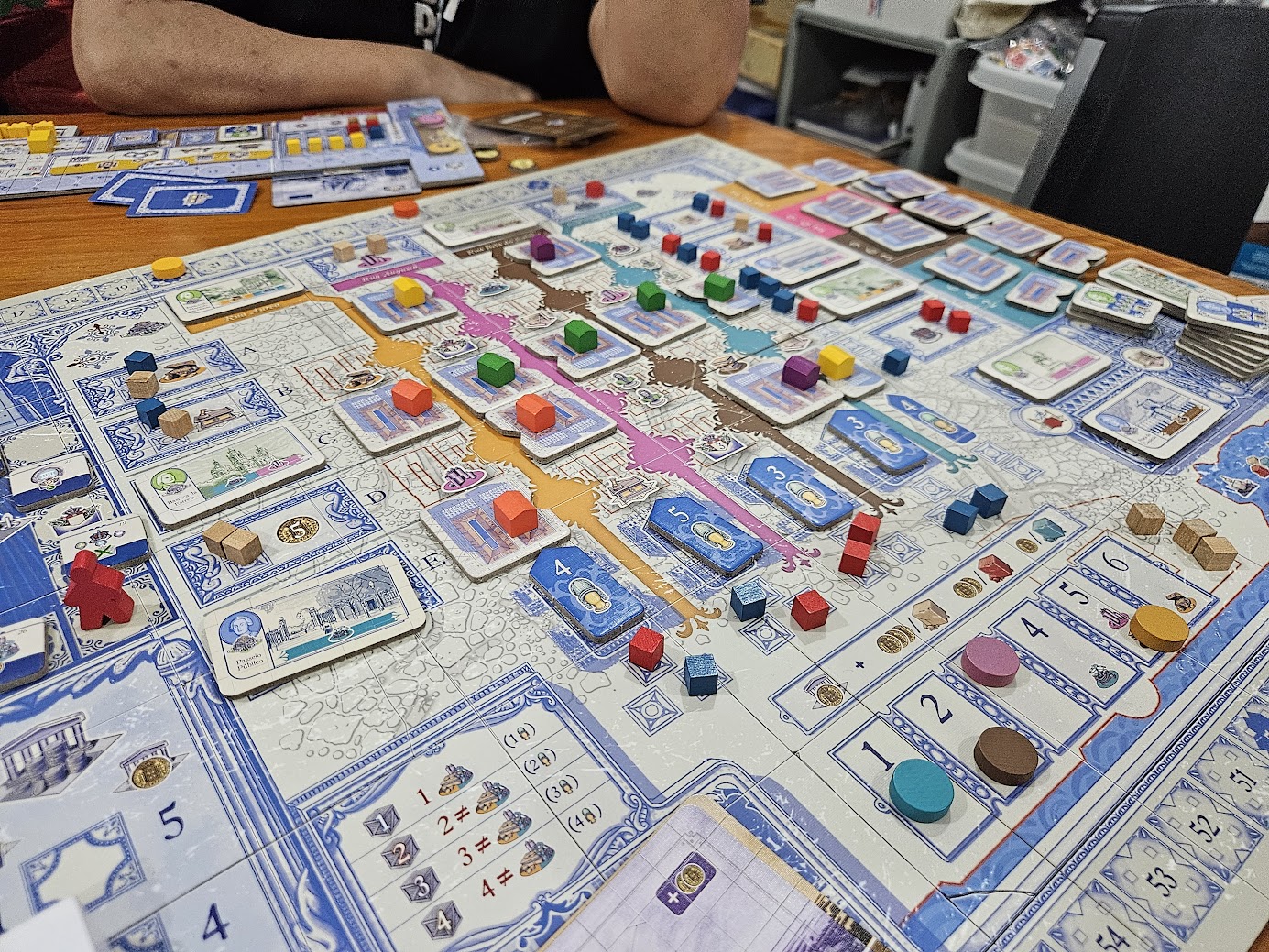

Lisboa
Official Description:
Lisboa is a game about the reconstruction of Lisbon after the great earthquake of 1755. On November 1, 1755, Lisbon suffered an earthquake of an estimated 8.5–9.0 magnitude, followed by a tsunami and three days of fires, which almost totally destroyed the city. The Marquis of Pombal, the Prime Minister, was tasked with the reconstruction of Lisbon, and he implemented a series of economic and political reforms to rebuild the city and its economy.
In the game, players represent the nobility of Lisbon who work with the King, the Marquis, and the builder to reconstruct the city. Players must manage resources, influence, and relationships with key figures to clear rubble, build stores and public buildings, and restore the city’s prosperity. The gameplay involves strategic planning, card management, and navigating the political and economic landscape of 18th-century Portugal.
Lisboa is a complex, euro-style game that combines historical events with deep strategic mechanics. Players compete to gain the most influence and prestige by contributing to the city’s reconstruction, balancing short-term gains with long-term objectives in a richly thematic setting.
Lisboa operates as a heavyweight Euro with a distinct focus on post-disaster reconstruction, channeling the genre’s tradition of layered decision-making and resource scarcity. The core system revolves around multi-use cards and a tightly interlocked action economy, demanding players constantly audit their options for maximum efficiency. This is not a game for the casual strategist; the mental friction is palpable, with every turn requiring a careful balance between immediate needs and long-term influence. Its consistent mechanical performance and solid table-time value are why it remains a regular fixture for groups seeking a deep, rewarding challenge—especially for those who appreciate the satisfaction of mastering a demanding core loop.
From a logistics standpoint, Lisboa’s premium Eagle-Gryphon edition is both a collector’s target and a practical challenge. The box is engineered for efficient storage, but only if you follow a specific packing sequence—deviate, and setup or teardown becomes a time sink. With a session time that reliably hits the two-hour mark and a setup that demands attention to detail, this is a main event title, best reserved for nights when the group is committed to a single, immersive experience. It’s not a filler or a spontaneous pick; it’s a deliberate choice that rewards preparation and focus.
Teaching Lisboa is a commitment. The system’s complexity means the first play is essentially a guided tutorial, and even experienced groups benefit from a veteran lead at the table. The game’s high friction—rooted in indirect competition and constant jockeying for position—keeps the energy sharp and the table fully engaged. Players walk away with a tangible skill dividend: a sharpened sense for multi-step planning, adaptive card play, and the ability to read and respond to shifting priorities under pressure. Once the group internalizes the logic, Lisboa delivers a uniquely fulfilling experience that justifies its place in any serious collection.
Category
Tactical & Strategy
My score
7
Our Total Plays
3
Last PLayed
26 Dec 25
🔥 In Rotation
Player Count
1-4
Playtime
120 mins
Proficiency Perks
Strategic Planning
Check Amazon
As an Amazon Associate, I earn from qualifying purchases.
← ALL BOARD GAMe REVIEWS