Harmonies
Official Description:
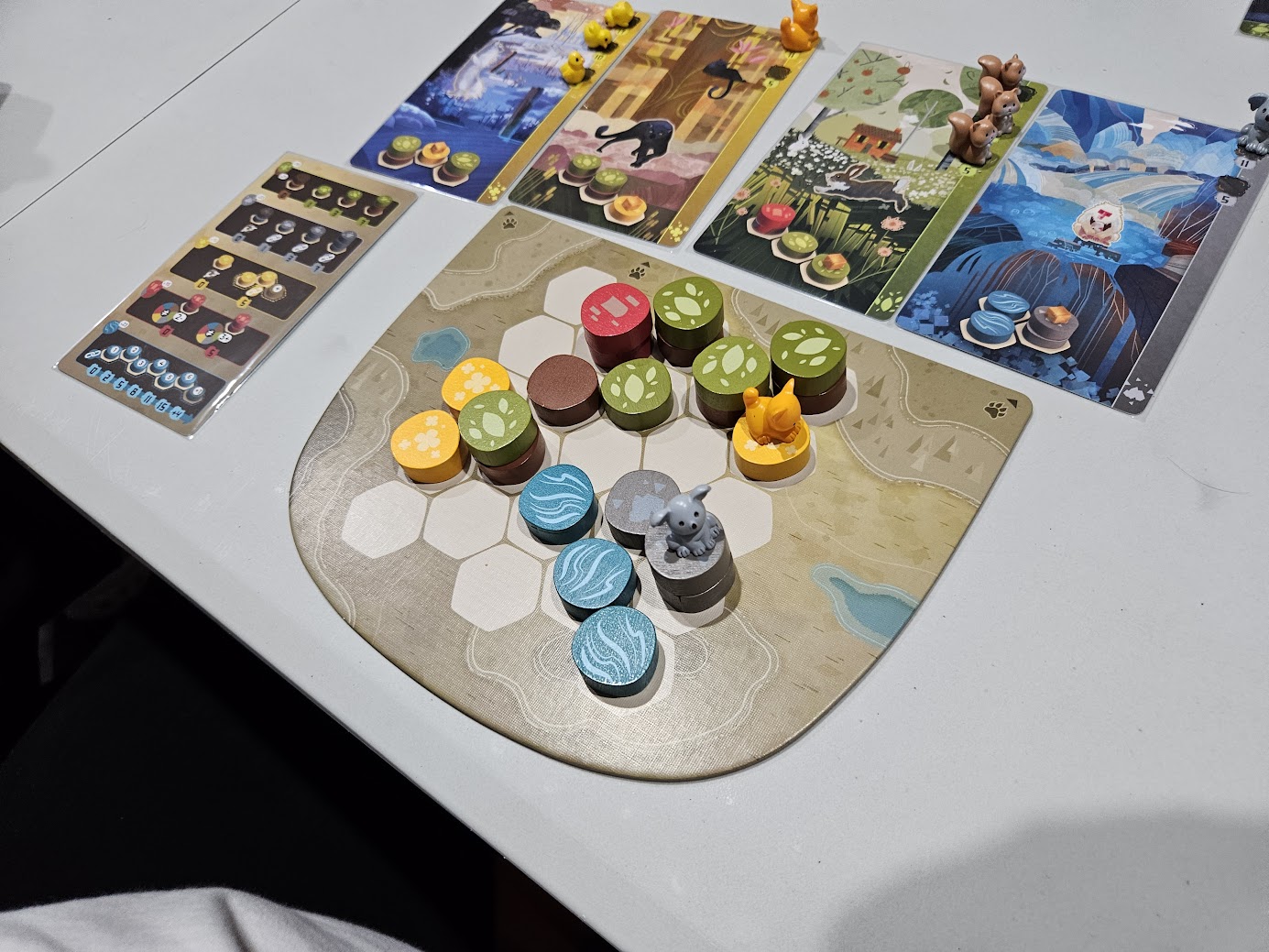
In Harmonies, players build landscapes by placing colored tokens and create habitats for their animals. The objective is to earn the most points by skillfully incorporating the animals’ preferred environments into the landscape. Each turn, players select tokens and strategically place them on their personal board, aiming to form specific patterns and combinations that fulfill the requirements of various animal cards.
The game challenges players to balance the creation of harmonious landscapes with the placement of animals, as each animal has unique habitat preferences. Players must think ahead and optimize their moves to maximize scoring opportunities, considering both immediate and long-term goals. The interplay between landscape building and animal placement forms the core of the game’s strategic depth.
Harmonies offers a blend of spatial puzzle and tactical decision-making, encouraging players to adapt their strategies based on available tokens and evolving board states. The game’s elegant mechanics and nature-inspired theme provide an engaging experience for those who enjoy thoughtful planning and creative problem-solving.
Harmonies operates in the tradition of spatial optimization games, where every token placement is a deliberate move toward a broader ecosystem goal. The interplay between landscape construction and animal card fulfillment creates a steady mental friction, rewarding those who can visualize patterns several turns ahead. Its consistent mechanical performance—reflected in its reliable table presence—makes it a dependable choice for regular rotation. The game’s current value lies in its ability to deliver a satisfying puzzle with enough tactical depth to keep seasoned players engaged, yet it avoids overstaying its welcome or bogging down the table with unnecessary complexity.
From a logistics standpoint, Harmonies is a model of efficiency. The box is compact, and the tactile wooden discs and quality components streamline both setup and teardown, fitting comfortably into a 15-minute prep window. With a 45-minute session time, it’s well-suited as a main event for a focused group or as a substantial anchor in a multi-game evening. The physical management is straightforward—component sorting is minimal, and the footprint is optimized for most table sizes, making it easy to deploy even in tighter spaces.
Teaching Harmonies is a procedural affair, best handled by someone familiar with managing active card limits and resource pools. The competitive structure keeps players invested, but the indirect interaction ensures the room stays focused rather than confrontational. The system’s core challenge is a sharp audit of spatial visualization and forward planning, offering a tangible skill dividend for those who enjoy pattern recognition and adaptive strategy. Once the initial rules are established, the game largely runs itself, allowing the host to step back and let the table’s energy build around clever plays and evolving landscapes.
Category
Tactical & Strategy
My score
7
Our Total Plays
9
Last PLayed
18 Oct 25
🔥 In Rotation
Player Count
1-4
Playtime
45 mins
Proficiency Perks
Strategic Planning
Spatial Reasoning
👑 PREMIUM
Play on BGA
Check Amazon
As an Amazon Associate, I earn from qualifying purchases.
← ALL BOARD GAMe REVIEWS