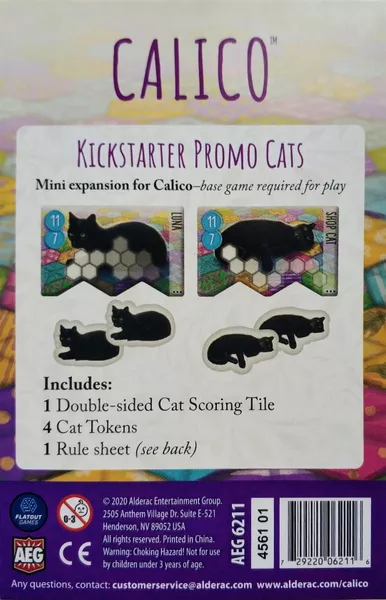
Calico
Official Description:
Calico is a puzzly tile-laying game of quilts and cats. In Calico, players compete to sew the coziest quilt as they collect and place patches of different colors and patterns. Each quilt has a specific pattern that must be followed, and players are also trying to create color and pattern combinations that are not only aesthetically pleasing but also able to attract the cuddliest cats.
During the game, players draft and place patch tiles onto their personal quilt board, aiming to complete design goals, create groups of colors to earn buttons, and arrange patterns to attract cats. Each turn, players select a patch tile from their hand and add it to their quilt, then draw a new tile from the communal supply. The challenge lies in balancing the competing objectives of fulfilling design goals, collecting buttons, and attracting cats, all within the limited space of the quilt.
At the end of the game, players score points based on how well they have met their design goals, the number of buttons collected, and the cats attracted to their quilt. The player with the highest score is declared the winner, having created the coziest and most attractive quilt.
Calico operates in the tradition of spatial optimization challenges, where every tile placement is a negotiation between immediate needs and long-term objectives. The restricted board space and overlapping goal systems—balancing cat-attraction patterns with button-earning color groups—demand a sharp audit of spatial visualization and forward planning. Its enduring presence in collections is no accident: the game’s consistent mechanical performance and solid table-time value have kept it relevant for years, even as newer tile-layers have come and gone. The inviting theme belies a system that quietly punishes missteps, rewarding those who can juggle multiple constraints under pressure. For a curator, Calico’s shelf retention is justified by its ability to deliver a tense, thinky experience in a compact, approachable package.
From a logistics standpoint, Calico is a model of efficient design. The dual-layer boards prevent accidental shifts, and the box contents are organized for quick setup and teardown—making it a reliable choice for sessions where time and table space are at a premium. With a 45-minute playtime and minimal component sprawl, it fits comfortably as a main event for smaller groups or a substantial closer for longer game nights. The inclusive design choices and clear iconography further reduce friction, ensuring that even with a full table, the physical management never overshadows the gameplay.
Teaching Calico is a procedural affair: expect a focused 20-minute rules overview, especially when clarifying the nuances of cat adjacency and the interplay between pattern-matching and button scoring. Once underway, the parallel play structure means players are absorbed in their own puzzles, allowing the host to step back after the initial teach. The system’s mental friction is substantial—players leave the table with a tangible boost to their pattern recognition and forward-planning skills. The low interaction keeps the room quietly intense, with each player locked into their own high-stakes spatial conundrum, making it ideal for groups that appreciate a cerebral, low-conflict environment.
Category
Tactical & Strategy
My score
7
Our Total Plays
5
Last PLayed
10 Oct 23
🏛️ Legacy
Player Count
1-4
Playtime
45 mins
Proficiency Perks
Strategic Planning
Spatial Reasoning
Check Amazon
As an Amazon Associate, I earn from qualifying purchases.
← ALL BOARD GAMe REVIEWS