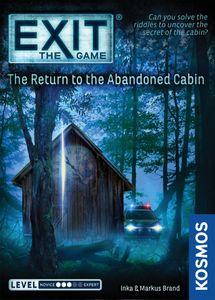
EXIT: The Game – The Return to the Abandoned Cabin
Official Description:
EXIT: The Game – The Return to the Abandoned Cabin is a cooperative escape room game designed for play at home. In this sequel to the original "The Abandoned Cabin," players are summoned by a police detective to revisit the mysterious cabin in the woods. The detective believes that the criminal from the previous case has resurfaced, and the players are needed to help solve new puzzles and uncover the truth behind the renewed threat.
The game challenges players to work together to solve riddles, crack codes, and unravel a series of interconnected puzzles. Using logic, observation, and teamwork, participants must decipher clues hidden throughout the game materials. The experience is immersive and narrative-driven, with each solved puzzle bringing players closer to the resolution of the story.
EXIT: The Game – The Return to the Abandoned Cabin is a single-use game, as players will need to mark, fold, and tear components during play. It is designed to provide a one-time, intense escape room experience that tests players' problem-solving skills and ability to collaborate under pressure.
EXIT: The Game – The Return to the Abandoned Cabin draws directly from its series roots, inviting players back to a familiar, atmospheric setting with a fresh set of escape room challenges. The narrative leans into nostalgia, rewarding those who recall the original’s twists while layering in new puzzles that demand both logic and teamwork. As a single-use, story-driven experience, it delivers consistent mechanical performance—offering solid table-time value for groups seeking a focused, collaborative session. For a curator, its solved status means it’s best deployed as a targeted experience for new players or as a thematic callback for veterans, rather than a repeat staple.
Physically, the game commands attention with its requirement to assemble a paper diorama, elevating the tactile engagement beyond standard card-based escape titles. Despite this, the box remains compact, making storage straightforward. Setup is more involved than most one-shot games, so it’s not a spontaneous filler—plan for it as a main event on your schedule. Ninety minutes is a realistic window for completion, and the immersive component build ensures the table feels active and invested throughout.
From a teaching perspective, the ruleset is approachable—most groups will be comfortable by the second puzzle, allowing the facilitator to step back and let the collaborative dynamic take over. The system’s mental friction is moderate, focusing on observation, deduction, and group communication rather than obscure logic leaps. The cooperative structure keeps the energy high, with everyone invested in cracking codes and piecing together clues. Players leave with a tangible sense of accomplishment and improved group problem-solving, making it a reliable secondary option for hosts looking to deliver a memorable, shared challenge.
Category
Thematic & Narrative
My score
7
Our Total Plays
1
Last PLayed
19 Jun 23
🔍 Solved
Player Count
1-4
Playtime
90 mins
Proficiency Perks
Systems & Logic
Check Amazon
As an Amazon Associate, I earn from qualifying purchases.
← ALL BOARD GAMe REVIEWS