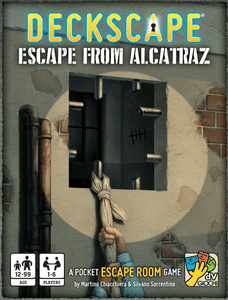
Deckscape: Test Time
Official Description:
Deckscape: Test Time is the first title in a series of cooperative games inspired by real escape rooms. In this game, a group of players is "trapped" inside a room and must work together to solve puzzles, decipher codes, and make choices that will allow them to escape within a set time limit. The game is designed to recreate the experience of a physical escape room using only a deck of cards, making it portable and accessible.
Players are challenged by Dr. Thyme, who needs help with his latest invention. However, things quickly go awry, and the group must solve a series of interconnected puzzles to prevent disaster. The game emphasizes teamwork, observation, and logical thinking, as players must discuss and agree on solutions to progress through the story.
Deckscape: Test Time is suitable for 1 to 6 players and can be played in a single session. The game does not require any components beyond the deck itself, and there is no need to write on or destroy any cards, allowing the game to be replayed or passed on to others.
Deckscape: Test Time operates as a portable, card-driven escape room, channeling the modular puzzle lineage into a single-session, narrative-driven experience. The time-travel premise is woven through a sequence of interconnected logic challenges, with Dr. Thyme’s malfunctioning invention providing a light narrative anchor. For a veteran curator, its current value lies in its solid table-time performance—once solved, the replay incentive drops, but its approachable structure and self-contained story make it a reliable secondary option for introducing new players to the escape room genre or for quick, collaborative sessions. The math-heavy focus of its puzzles delivers consistent mechanical performance, though the system would benefit from broader puzzle diversity to sustain long-term shelf retention.
Physically, the game is a model of efficiency: a compact box housing a single deck, with no extraneous components or setup overhead. This makes it ideal for situations where space and time are at a premium—travel, conventions, or as a spontaneous addition to a game night. With a 90-minute session time, it sits comfortably as a main event for smaller groups or as a focused activity between larger games. The minimal footprint and straightforward reset process mean it can be deployed with little advance notice, and its portability ensures it’s always ready for a quick session without logistical headaches.
From a teaching perspective, Deckscape: Test Time is notably accessible. The guided deck sequence and tutorial cards allow even first-time facilitators to introduce the system with minimal prep, and the collaborative structure means the group can self-manage after the initial explanation. The mental friction centers on group logic and numeric reasoning, rewarding teams that communicate and cross-check solutions. The pure cooperative format keeps the room’s energy focused and inclusive, making it a dependable choice for mixed-experience groups or as a low-barrier entry point for puzzle enthusiasts.
Category
Thematic & Narrative
My score
7
Our Total Plays
1
Last PLayed
17 Jan 22
🔍 Solved
Player Count
1-6
Playtime
90 mins
Proficiency Perks
Systems & Logic
Check Amazon
As an Amazon Associate, I earn from qualifying purchases.