
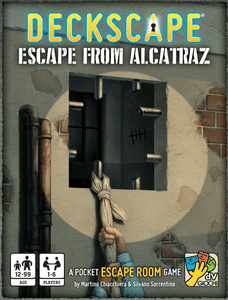
Deckscape: Escape from Alcatraz
Official Description:
Deckscape: Escape from Alcatraz is a cooperative card game inspired by real escape rooms, in which a group of players is challenged to solve puzzles, understand the plot, and make intelligent use of the items provided in order to escape from the infamous Alcatraz prison. The game is set in 1950, and players awaken as prisoners with no memory of how they arrived. Their objective is to work together, using logic and observation, to unravel the mysteries and escape before time runs out.
The game is designed for 1 to 6 players and offers a unique, story-driven experience. Players progress through a deck of cards, each presenting new puzzles and narrative elements. Choices made during the game can affect the outcome, and the group must decide how to proceed at critical junctures, balancing risk and reward as they attempt to break free from their cells and outsmart the prison's security.
Deckscape: Escape from Alcatraz emphasizes teamwork, deduction, and creative problem-solving. The game does not require any components to be destroyed, allowing it to be replayed or shared with others. Its compact format and engaging storyline make it accessible for both newcomers and experienced escape room enthusiasts.
Deckscape: Escape from Alcatraz operates as a pure analog escape room, distilling the tension of a prison break into a compact, card-driven system. The 1950s Alcatraz setting is more than window dressing; it shapes the progression and stakes, with each card flip advancing both the narrative and the puzzle logic. The clever branching structure introduces genuine decision points—players must collectively weigh risks and manage limited information, echoing the high-stakes teamwork of classic escape fiction. For a collection with nearly two decades of curation behind it, this title earns significant long-term shelf retention: its high operational reliability comes from a design that delivers a full, story-rich experience without digital dependencies or component fatigue. Its solved status means it’s best deployed as a one-shot event or passed along to new groups, but the analog depth and resettable format keep it relevant for teaching and lending.
Physically, this is the definition of efficient design—no wasted space, no extraneous components, and a footprint that fits in a jacket pocket. Setup is instantaneous; the box opens, and play begins. There’s no risk of lost pieces or fiddly prep, and the non-destructive format means the game can be reset for the next group without any maintenance. With a 60-minute session time, it’s best positioned as a focused main event for a small group, especially when you want a contained, high-engagement experience that doesn’t require a sprawling table or a lengthy teardown. For hosts managing multiple tables or tight schedules, it’s a reliable option that won’t disrupt the flow of a game night.
From a teaching perspective, Deckscape: Escape from Alcatraz is as frictionless as it gets—just flip the first card and the system onboards itself. The collaborative structure ensures that everyone is engaged, with the mental friction coming from deduction, observation, and group communication rather than procedural overhead. The skill dividend here is collective reasoning under pressure; players sharpen their ability to synthesize clues, communicate findings, and make consensus decisions. The high interaction level keeps the room’s energy up, making it ideal for groups that thrive on shared problem-solving rather than parallel play. For a facilitator, it’s a rare case where you can introduce the game and then step back, confident that the system will keep the table engaged from start to finish.
Category
Thematic & Narrative
My score
8
Our Total Plays
1
Last PLayed
29 Jan 23
🔍 Solved
Player Count
1-6
Playtime
60 mins
Proficiency Perks
Systems & Logic
Check Amazon
As an Amazon Associate, I earn from qualifying purchases.
← ALL BOARD GAMe REVIEWS


