
Come Sail Away!
Official Description:
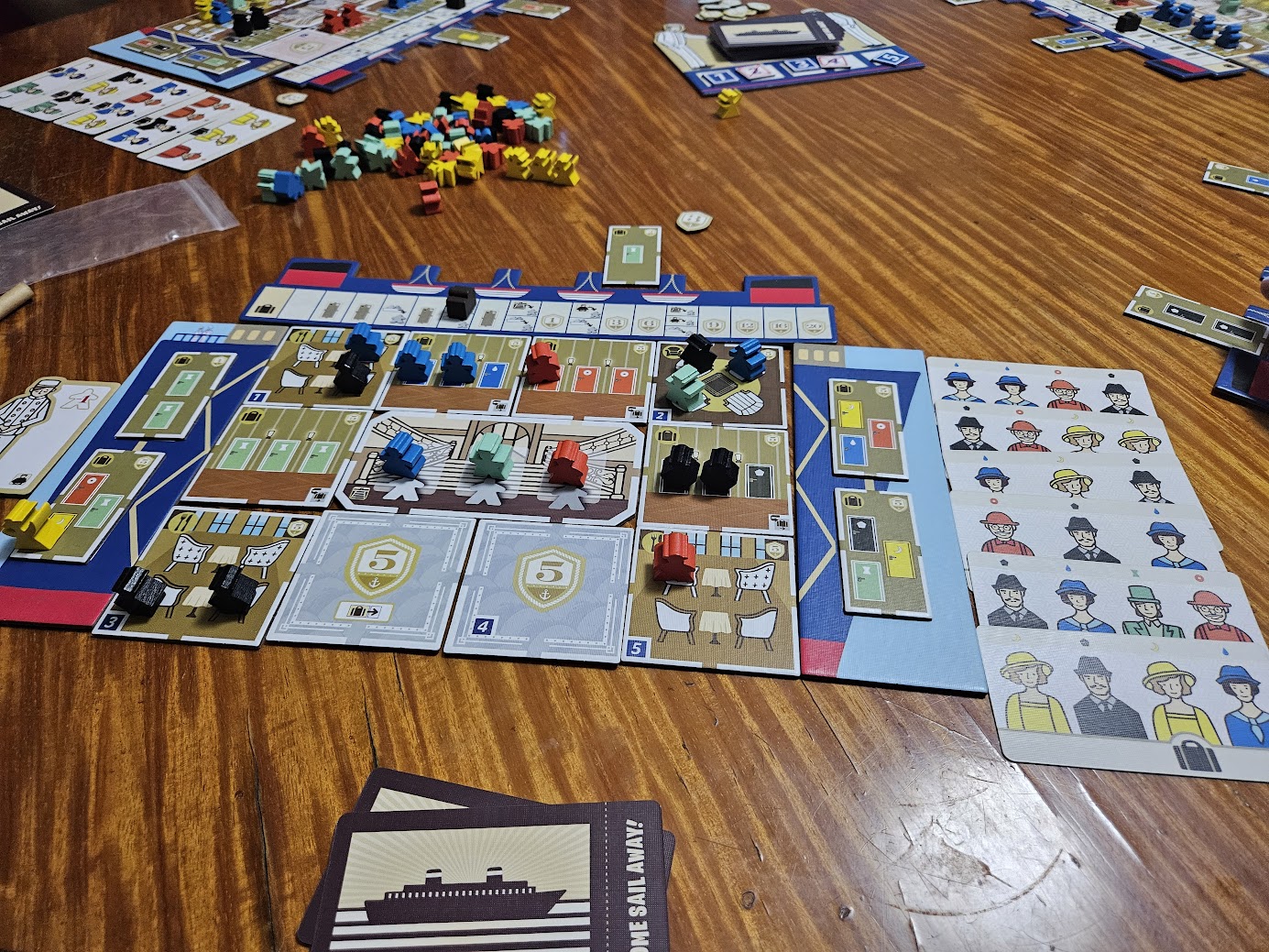
Come Sail Away! is a board game for 1-4 players in which you compete to board passengers onto your luxury liner, bringing them to their favorite cabins and ensuring their luggage is delivered to the correct rooms. The game features a mancala-inspired mechanism, where players distribute passengers along the ship’s corridors, aiming to optimize their placement and maximize points.
Players must carefully plan their moves to efficiently fill cabins, deliver luggage, and fulfill passenger preferences. The game challenges players to balance immediate tactical decisions with long-term strategy, as each action can impact future options and scoring opportunities.
With its blend of puzzle-like mechanics and strategic depth, Come Sail Away! offers a unique experience for both solo and group play, emphasizing careful planning and adaptability as players strive to create the most successful voyage for their passengers.
Come Sail Away! draws from the tradition of quick-play, puzzle-centric fillers, but elevates the formula with a cruise ship theme and a rhythmic passenger deployment system. The Saashi/Chow collaboration delivers a mancala-inspired mechanism that demands players sequence their moves with care, as each guest must be placed with an eye toward both immediate and future scoring. While the game’s roots are in the casual and filler space, its consistent mechanical performance and rewarding spatial crunch have earned it significant long-term shelf retention among veteran collections. Its status as a proven classic is reinforced by years of steady table presence, offering a reliable secondary option for groups seeking a brisk, yet thoughtful, competitive experience.
Physically, the game arrives in a larger Saashi box, which is notable for its clean design despite the increased footprint and the abundance of passenger meeples. Setup is straightforward but not instantaneous; expect a brief period to organize components before play. With a 25-minute session time, it fits comfortably as a substantial opener or a satisfying closer for a game night, rather than a mere gap-filler. The tactile engagement of moving passengers and managing the ship’s layout adds to the table presence, making it a conversation piece without overstaying its welcome.
From a teaching perspective, Come Sail Away! sits firmly in the procedural camp. The rules require a focused 20-minute introduction, particularly to clarify the nuances of passenger movement and cabin optimization. Once underway, the system’s competitive edge keeps players invested, and the board’s design performs a sharp audit of each player’s spatial visualization and forward planning. The mental friction is rewarding—players leave the table with a tangible sense of having navigated a tight, interactive puzzle. The indirect competition for optimal placements keeps the energy high, ensuring that even with a veteran group, the game remains engaging and replayable.
Category
Casual & Filler
My score
7
Our Total Plays
1
Last PLayed
01 May 24
🏛️ Legacy
Player Count
1-4
Playtime
25 mins
Proficiency Perks
Strategic Planning
Spatial Reasoning
Check Amazon
As an Amazon Associate, I earn from qualifying purchases.
← ALL BOARD GAMe REVIEWS