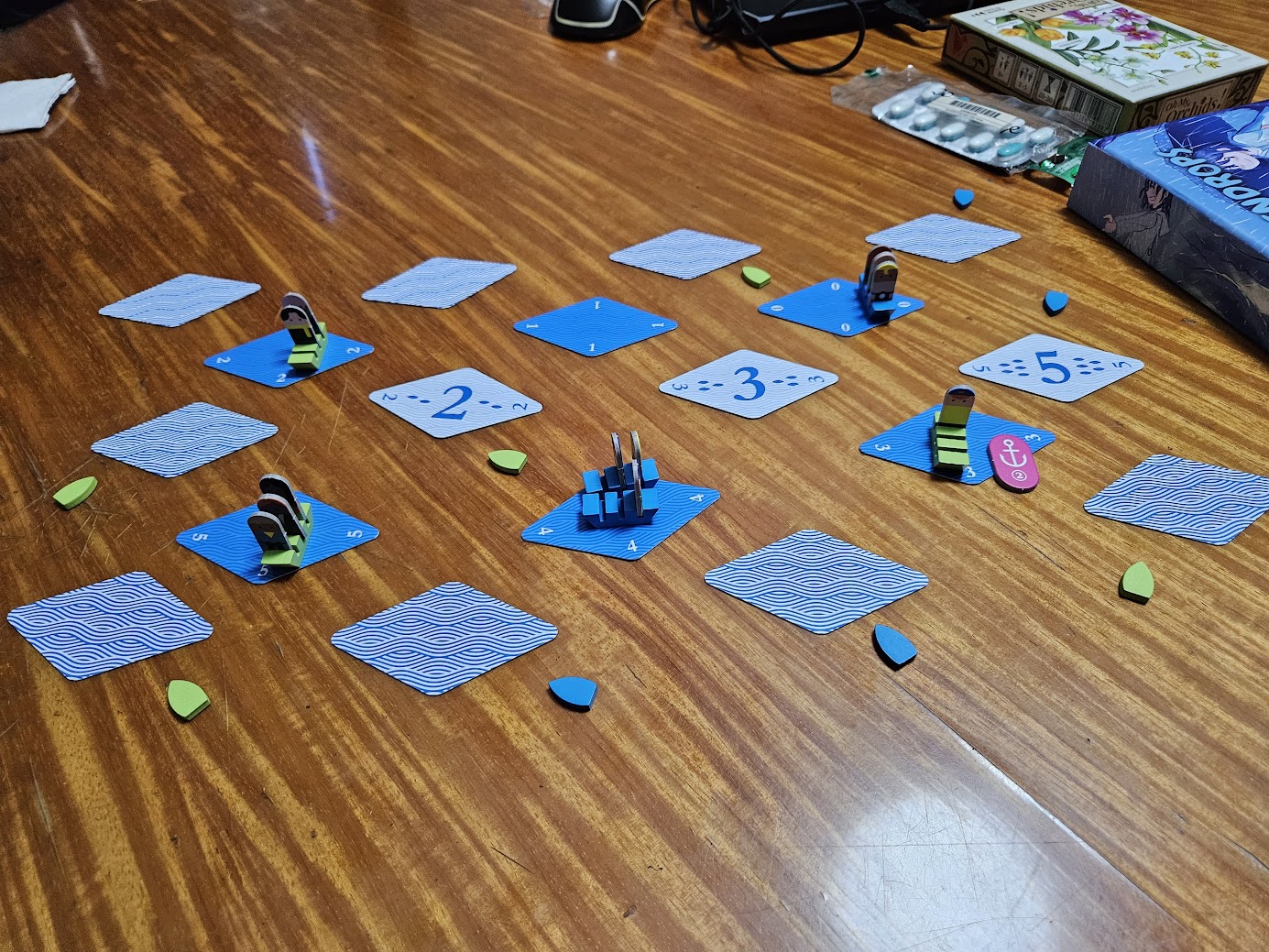

Whale to Look
Official Description:
A bay full of huge whales and orcas, and quite popular among whale-watching tourists, is becoming overrun with four companies. The whales, on the other hand, are not so happy about this situation and are trying to avoid the tourists as much as possible. In Whale to Look, players take on the role of tour companies, sending out boats to try to spot whales and orcas while deducing their locations based on limited information.
Each round, players secretly choose where to send their boats, aiming to position themselves where the whales and orcas will appear. The whales’ movements are determined by hidden information, and players must use deduction and observation to predict their locations. Success depends on both clever deduction and strategic placement, as only those who manage to spot the whales will be able to keep their tourists happy.
The game combines elements of deduction, hidden movement, and tactical decision-making, offering a unique whale-watching experience. Players must balance risk and reward, outmaneuver their competitors, and adapt to the unpredictable behavior of the whales to become the most successful tour company in the bay.
Whale to Look operates in the tradition of compact, quick-fire deduction games, but its procedural depth and competitive tension set it apart from the usual filler fare. The Oink-sized box belies a system that rewards careful observation and calculated risk, as rival tour operators maneuver for prime whale-watching spots while contending with hidden marine movement. Its blend of deduction and tactical placement, paired with the need to distinguish between whale and orca scoring, delivers a consistent mechanical performance—making it a reliable secondary option for groups that appreciate a sharper edge in their lighter games. Its continued presence in collections after years of shelf competition speaks to its solid table-time value and the enduring appeal of its tense, information-driven gambit.
From a logistics standpoint, Whale to Look is a model of efficiency. The standard Oink footprint means setup is minimal—wooden whale pieces and tiny tourist tokens are all that’s needed to get underway, and the game’s 30-minute session time fits neatly between heavier titles or as a closer for the night. The physical management is straightforward, with components that are both charming and functional, making it easy to deploy in tight spaces or on the go. For hosts, it’s best positioned as a high-engagement filler or a palate-reset between longer games, offering a quick but meaningful contest without monopolizing the table.
Teaching Whale to Look requires a procedural approach: clarifying the distinction between whale and orca scoring, and ensuring players grasp how investigation cards reveal positions. Once the basics are established, the system’s mental friction becomes apparent—players must synthesize limited information, anticipate opponents, and adapt to shifting probabilities. The competitive interaction keeps the room alert and invested, as every round’s outcome hinges on both deduction and bluffing. While the teach demands a steady hand, the game’s structure allows a veteran to step back after the first round, letting the table’s energy drive itself as players chase the skill dividend of sharper deduction and tactical foresight.
Category
Casual & Filler
My score
7
Our Total Plays
1
Last PLayed
09 Jul 23
🏛️ Legacy
Player Count
2-5
Playtime
30 mins
Proficiency Perks
Strategic Planning
Systems & Logic
Check Amazon
As an Amazon Associate, I earn from qualifying purchases.
← ALL BOARD GAMe REVIEWS