The Secret Flower
Official Description:
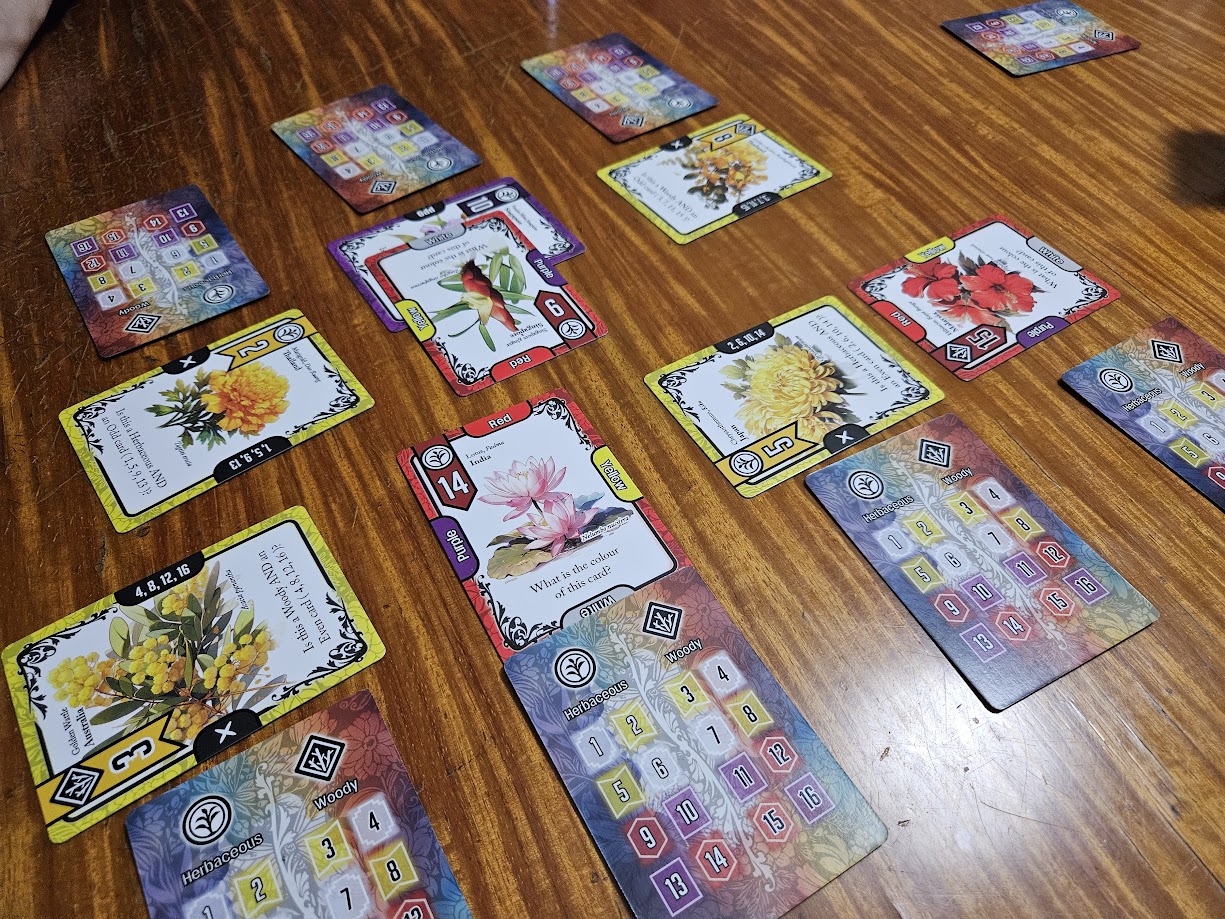
The Secret Flower is a cooperative deduction micro-game consisting of 16 cards. Players work together to deduce the identity of a single secret card using limited communication. Each round, players give clues by playing cards to each other's secret card, with the aim of piecing together partial information to solve the mystery.
The game emphasizes teamwork and deduction, as players must interpret the clues provided by their teammates while adhering to strict communication rules. The challenge lies in making the most of the limited information available and coordinating effectively without direct discussion about the secret card.
Designed for quick play and portability, The Secret Flower offers a compact yet engaging experience that tests players' logic and cooperative skills. Its minimal components and streamlined rules make it accessible for both new and experienced gamers looking for a fast-paced deduction challenge.
The Secret Flower operates as a micro-cooperative deduction system, distilled into a sixteen-card format that strips away excess and focuses on pure collaborative logic. Its minimalist approach is deceptive; beneath the surface, the game demands sharp attention to the nuances of clue-giving and interpretation, rewarding groups that can coordinate without explicit communication. As a former promotional item that has persisted in collections for years, its continued presence signals selective deployment only—its shelf retention is driven by the unique mental friction it offers rather than broad appeal. For a veteran curator, its value lies in providing a focused, high-trust deduction challenge that stands apart from more elaborate deduction titles, making it a specialized tool for groups seeking a concentrated cooperative puzzle.
Physically, The Secret Flower is about as streamlined as it gets: sixteen cards in a sleeve, ready to deploy at a moment’s notice. Setup is instantaneous, and the game’s footprint is so minimal it can be played almost anywhere—ideal for filling short gaps or as a portable option for travel or conventions. However, its compactness also means it’s best suited as a quick interlude or a warm-up rather than a main event; the experience is shaped by the intensity of player discussion, so session length can flex, but rarely overstays its welcome. For hosts, it’s a reliable backup for moments when time or space is at a premium.
From a teaching perspective, the rules are light enough that most groups will be comfortable by the second round, allowing the facilitator to step back and let the table drive the experience. The core skill dividend is in collaborative deduction—players must learn to ask the right questions and interpret partial information, sharpening their ability to communicate under constraints. The pure cooperative structure keeps the room engaged and invested in a shared outcome, often sparking lively post-game analysis. For groups that thrive on teamwork and logic, The Secret Flower delivers a focused, high-interaction session with minimal overhead.
Category
Thematic & Narrative
My score
6
Our Total Plays
1
Last PLayed
08 Feb 24
🏛️ Legacy
Player Count
2-5
Playtime
20 mins
Proficiency Perks
Systems & Logic
Check Amazon
As an Amazon Associate, I earn from qualifying purchases.
← ALL BOARD GAMe REVIEWS