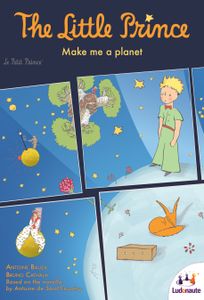
The Little Prince: Make Me a Planet
Official Description:
In The Little Prince: Make Me a Planet, each player builds their own planet to provide a beautiful home for the animals dear to The Little Prince. Players take turns selecting tiles to construct a planet made up of sixteen tiles, arranging them in a four-by-four grid. The goal is to create the most harmonious and valuable planet by carefully choosing tiles that feature different landscapes and characters from the beloved story.
Throughout the game, players must balance the placement of various elements such as volcanoes, baobabs, and animals, as well as the influence of characters who provide unique scoring opportunities. The drafting mechanism requires strategic thinking, as players must not only consider their own planet’s needs but also anticipate the choices of their opponents. The interaction between players is heightened by the ability to influence the options available to others during the drafting phase.
At the end of the game, each player’s planet is scored based on the specific criteria provided by the characters surrounding their planet. The player with the highest score, having best met the needs of their characters and created the most appealing planet, is declared the winner. The game combines accessible rules with engaging strategy, making it suitable for both families and experienced gamers.
Tile selection in The Little Prince: Make Me a Planet delivers a sharp, competitive edge beneath its storybook exterior. Despite its roots in the Casual & Filler tradition, the game’s tile-drafting phase is anything but gentle—players routinely sabotage each other’s plans, especially when baobabs threaten to ruin a planet. The system’s high operational reliability is evident in its ability to generate tense, meaningful decisions in under half an hour, making it a current favorite for groups seeking a quick but substantial contest. Its ongoing popularity in my collection is a direct result of this blend: approachable rules, but a skill ceiling that rewards repeat play and tactical adaptation.
From a logistics standpoint, the compact tile box and sturdy cardboard components make setup and teardown refreshingly efficient. The back-of-box score track is a practical touch, and the entire package fits easily on even the most crowded shelf. With a 25-minute session time and minimal prep, it’s ideal as a lead-in or closer for a game night, or as a reliable filler between heavier titles. The physical footprint is modest, and the game’s structure ensures that even with a full table, downtime is minimal and the pace stays lively.
Teaching this system is straightforward—most groups are comfortable by the second round. The main teaching hurdles are clarifying how baobabs can end a player’s chances, explaining the character-based scoring, and ensuring everyone understands the tile placement and turn-order mechanics. Once underway, the game’s competitive interaction keeps the table alert, as players must constantly audit both their own planet and their rivals’ boards. The mental friction here is rooted in spatial visualization and forward planning, offering a skill dividend that lingers well after the session. The energy in the room tends to escalate as the planets fill out and the consequences of early choices become clear, making it a satisfying, if occasionally ruthless, group experience.
Category
Casual & Filler
My score
8
Our Total Plays
17
Last PLayed
22 Jan 26
🔥 In Rotation
Player Count
2-5
Playtime
25 mins
Proficiency Perks
Strategic Planning
Spatial Reasoning
Check Amazon
As an Amazon Associate, I earn from qualifying purchases.
← ALL BOARD GAMe REVIEWS