Tend
Official Description:
Tend is a "flip and write" game where players each build up their own farm and collect the greatest selection of goods to send back to Zenith HQ for evaluation. Each player manages their own homestead, making strategic decisions about which crops to plant, which animals to raise, and how to best utilize their resources. The game emphasizes careful planning and optimization as players compete to create the most successful and diverse farm.
Throughout the game, players flip cards to determine available actions and resources, then write their choices on their individual farm sheets. The gameplay involves balancing short-term gains with long-term strategies, as players must adapt to changing circumstances and opportunities presented by the card flips. The goal is to maximize the value and variety of goods produced on the farm, with each decision impacting the final outcome.
Tend offers a blend of tactical choices and strategic depth, making it suitable for players who enjoy resource management and planning. The game is designed for multiple players, with each participant working independently but competing for the highest score based on the quality and diversity of their farm's output.
Tend positions itself as a sprawling flip-and-write, aiming for the kind of grand-scale optimization usually reserved for heavier Euro designs. Its tactical DNA is rooted in resource management and adaptive planning, with each player independently cultivating their own farm tableau. The system’s mental friction comes from balancing immediate gains against long-term diversification, all while interpreting a steady stream of icons and symbols that can easily trip up even experienced players. As a recent addition to the collection, Tend currently offers solid table-time value—its consistent mechanical performance makes it a reliable secondary option for groups seeking a meaty, parallel-play experience without direct conflict. For a veteran curator, its current status as a new arrival means it’s still under review for long-term shelf retention, but its ambition and scope justify a closer look.
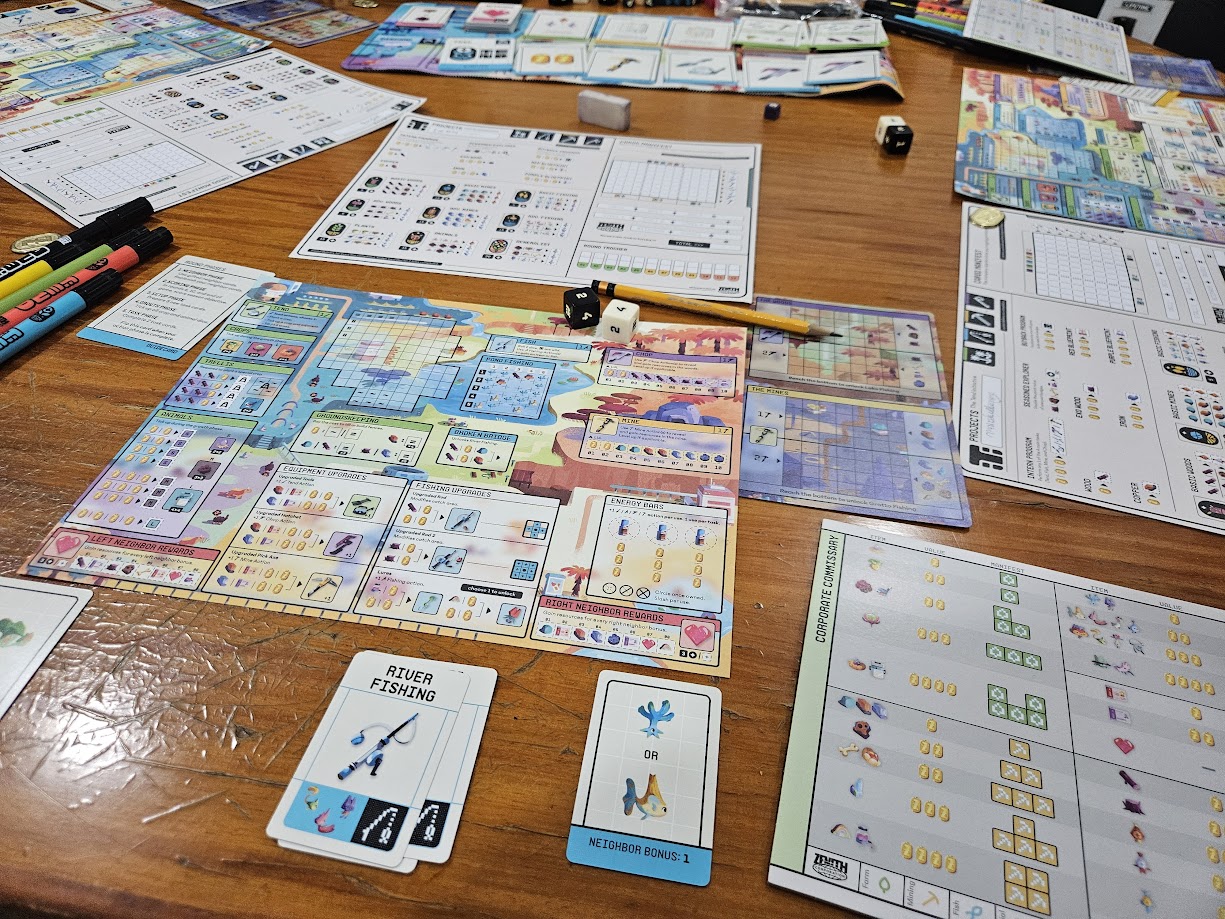
From a logistics standpoint, Tend is unapologetically demanding. The box contents sprawl across the table, with individual player sheets, decks of cards, and a layout that leaves little room for comfort. Tiny fonts and cramped writing spaces add to the setup and teardown time, pushing this firmly into the main event slot for any game night. Expect a 90-minute session that requires advance planning and a dedicated surface—this is not a filler or a casual warm-up. The oversized presentation, while visually impressive, can feel excessive compared to the underlying gameplay, and the physical management of components is a real consideration for hosts used to more streamlined systems.
Teaching Tend is a technical affair. The iconography, especially around alien resources and fish symbols, demands careful explanation and repeated clarification. With parallel play at its core, the system allows a facilitator to step back once the initial hurdles are cleared, but only after ensuring everyone is comfortable with the icon set and scoring nuances. The primary skill dividend here is in forward planning and adaptive optimization—players will leave with sharpened resource management instincts and a better sense of how to pivot strategies mid-game. The low interaction level keeps the room focused and relatively quiet, making it ideal for groups that prefer thoughtful, individual play over table talk or negotiation.
Category
Tactical & Strategy
My score
7.5
Our Total Plays
3
Last PLayed
04 Apr 26
🔥 In Rotation
Player Count
1-6
Playtime
90 mins
Proficiency Perks
Strategic Planning
Check Amazon
As an Amazon Associate, I earn from qualifying purchases.


