
SCOUT
Official Description:
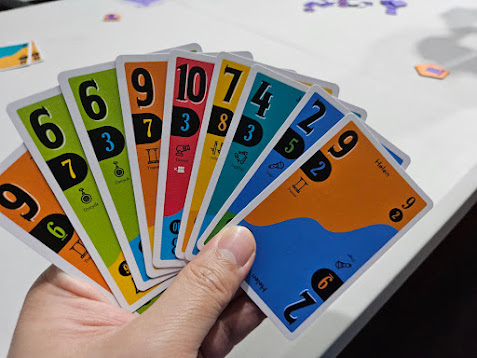
SCOUT is a ladder-climbing card game in which each card has two potential values, and players are not allowed to rearrange the cards in their hand. On a player's turn, they may either play a set of cards to beat the current set on the table or take a card from the table into their hand, which is called "scouting." When scouting, the player can insert the new card anywhere in their hand, but otherwise, the order of cards must remain unchanged.
The game challenges players to manage their hand efficiently, as the inability to rearrange cards adds a layer of strategy and planning. Players must decide when to play combinations to win tricks and when to scout to improve their hand for future turns. The dual values on each card provide additional tactical options, as players can flip cards to use the alternate value when adding them to their hand.
SCOUT rewards careful observation of opponents' plays and strategic timing. The game continues until all cards have been played, and points are awarded based on the cards won and the successful plays made. The unique mechanics of fixed hand order and dual-value cards set SCOUT apart from traditional ladder-climbing games, offering a fresh and engaging experience.
SCOUT operates within the tradition of compact, high-interaction card games, but its fixed hand order and dual-value cards inject a sharp layer of mental friction rarely seen in the genre. The inability to rearrange cards forces players to engineer their set-building under strict constraints, rewarding those who can spot tactical pivots and time their scout actions precisely. This is not just a clever twist—it’s a system that has earned significant long-term shelf retention, surviving years of table competition thanks to its tense, satisfying decision space. Its legacy status is well-earned; after nearly two decades of managing tables, I’ve seen few casual-length games maintain this level of operational reliability and replay demand.
From a logistics standpoint, SCOUT is a model of efficiency. The standard Oink Games box is genuinely pocket-sized, and the high-contrast cards are easy to read across a crowded table. Setup is as simple as shuffling and dealing, making it a natural fit for those moments between heavier games or as a quick opener. With a session time of about 20 minutes, it’s ideal for filling gaps or resetting the table’s energy without sacrificing engagement. There’s no component sprawl or fiddly prep—just cards, clear rules, and immediate playability.
Teaching SCOUT is refreshingly straightforward. The rules are internalized by the second round, and the competitive structure keeps everyone invested from the first play. The system’s main skill dividend is in sequencing and timing—players must read the table, anticipate opponents’ moves, and optimize their own hand under pressure. The direct competition and constant tactical recalibration keep the room lively, with every play and scout action sparking discussion and recalculation. For hosts, it’s a game you can introduce, step back, and watch the table come alive—no ongoing hand-holding required.
Category
Casual & Filler
My score
8
Our Total Plays
1
Last PLayed
22 Nov 24
🏛️ Legacy
Player Count
2-5
Playtime
20 mins
Proficiency Perks
Strategic Planning
Check Amazon
As an Amazon Associate, I earn from qualifying purchases.
← ALL BOARD GAMe REVIEWS