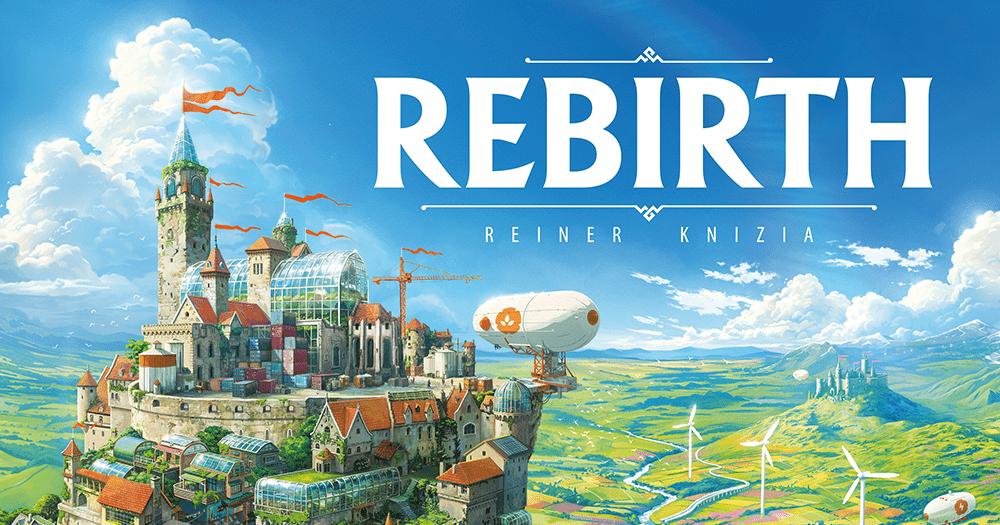
Rebirth
Official Description:
Rebirth is a tile-laying game designed by Reiner Knizia and published by Mighty Boards. Set in a lush, hopeful future, players are tasked with rebuilding old lands that have been revitalized. The game combines classic tile-laying mechanics with modern strategic elements, offering a fresh take on the genre.
Players compete to restore regions by placing tiles and establishing connections across the board. The gameplay emphasizes tactical decision-making, as each move can influence the development of the shared landscape and the opportunities available to all participants. The objective is to contribute most effectively to the rebirth of the land, balancing immediate gains with long-term planning.
Rebirth is designed for accessibility and depth, making it suitable for both newcomers and experienced gamers. Its streamlined rules and engaging gameplay encourage replayability, while the shared board fosters interaction and competition among players.
Rebirth operates in the tradition of Knizia’s most punishingly elegant tile-layers, but with a modern edge: two distinct maps, a single-tile hand, and a restoration theme that’s more hopeful than most. The system’s high operational reliability comes from its dual scoring modes—each map fundamentally shifts the win conditions, forcing players to recalibrate their approach without relearning the core mechanics. Every turn is a sharp audit of your spatial foresight and timing, as you’re always one tile away from a breakthrough or a misstep. Its current momentum is no accident; the game’s significant long-term shelf retention is driven by the way it rewards repeated play and adapts to different groups, making it a top-tier strategic dividend for any collection focused on modern tile-laying.
From a logistics standpoint, Rebirth is a model of efficiency. Mighty Boards’ production values are immediately apparent: sustainable ReWood™ components have a satisfying heft, the iconography is clear, and the insert is engineered for quick setup regardless of which map you’re using. With a 60-minute session time and a setup that rarely exceeds a quarter-hour, it’s well-suited as a main event for focused groups or as a reliable anchor for a night of modern Euros. The box contents are organized to minimize downtime, and the tactile quality of the components encourages repeat play without fatigue.
Teaching Rebirth is a procedural affair—expect a 20-minute rules brief, especially if you’re highlighting the differences between the two maps and clarifying the occasionally confusing location names. The system’s competitive tension is ever-present; with only one tile in hand, players are constantly forced into high-stakes decisions, and the shared board ensures that every move is scrutinized. The skill dividend here is substantial: players leave with a sharpened sense of spatial planning and adaptive strategy, and the indirect competition keeps the table engaged and invested throughout. For hosts, it’s a game you can teach, monitor for a few rounds, and then let run—though you’ll want to stay close for the first map switch or two. The energy in the room stays high, as every placement can shift the balance of power.
Category
Tactical & Strategy
My score
8
Our Total Plays
7
Last PLayed
22 Aug 26
🚀 High Velocity
Player Count
2-4
Playtime
60 mins
Proficiency Perks
Strategic Planning
Check Amazon
As an Amazon Associate, I earn from qualifying purchases.
← ALL BOARD GAMe REVIEWS