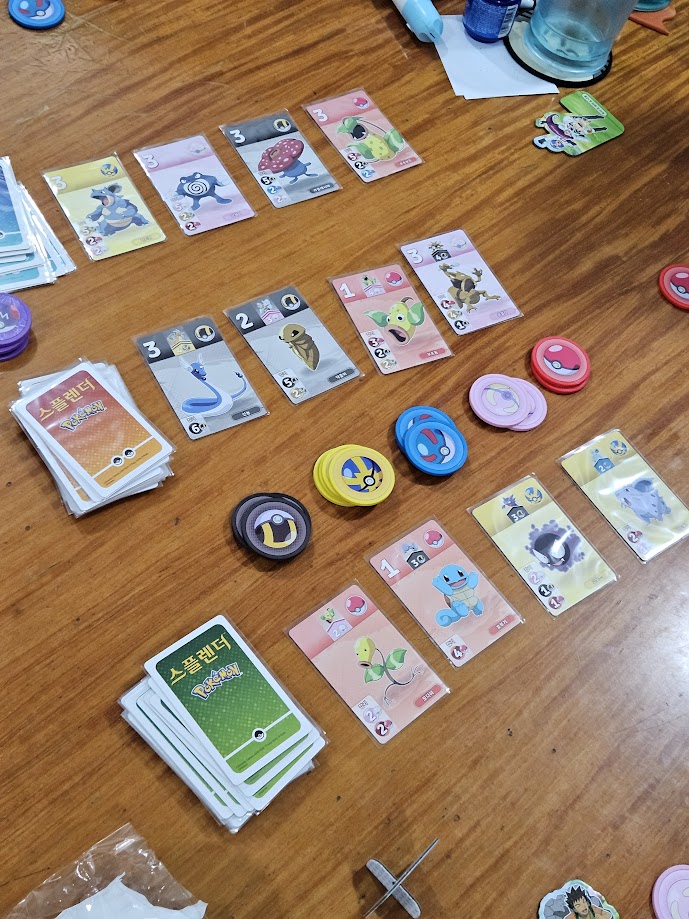

스플렌더: Pokémon (Splendor: Pokémon)
Official Description:
Splendor: Pokémon is a reimagining of the classic Splendor game, incorporating the world of Pokémon. Players take on the role of Pokémon trainers, collecting Pokéballs and recruiting Pokémon to build the most impressive team. The game maintains the core mechanics of Splendor, where players collect resources and use them to acquire cards, but introduces special rules and thematic elements unique to the Pokémon universe.
Throughout the game, players gather different types of Pokéballs, which serve as resources to recruit Pokémon cards of increasing value and power. The evolution mechanic allows players to upgrade their Pokémon, reflecting the progression seen in the Pokémon series. The objective is to assemble a team that attracts the attention of legendary Pokémon, earning prestige points and ultimately achieving victory.
Splendor: Pokémon offers a blend of strategic resource management and thematic gameplay, appealing to both fans of the original Splendor and Pokémon enthusiasts. The game is designed for accessibility and replayability, with familiar mechanics enhanced by the addition of Pokémon-themed rules and artwork.
Splendor: Pokémon operates as a competitive engine-builder rooted in the classic Euro-style resource loop, but with a vertical progression twist thanks to its evolution mechanic. The familiar rhythm of collecting and converting resources is now layered with bonus actions and evolving card chains, which audit a player’s sequencing and timing under pressure. This isn’t just a thematic reskin; the evolution system rewards tactical cycling of lower-tier cards, adding a sharp edge to the decision space and increasing the mental friction for veterans who crave more than rote optimization. Its high operational reliability is evident in how often it hits the table—this is a title with significant long-term shelf retention, earning its place in active rotation for groups who want a brisk, strategic contest with a familiar backbone.
Physically, the game mirrors the standard Splendor footprint: a compact box, oversized poker-chip currency, and a card market that’s easy to deploy. The components are robust, but the box contains more air than content, so storage efficiency isn’t its strong suit. Setup and teardown are straightforward, making it a practical 30-minute session—ideal as a main event for lighter nights or a reliable anchor between heavier games. The tactile chips and clear card market keep the table state readable, and the Pokémon theme draws immediate attention, especially for mixed-experience groups.
From a teaching perspective, Splendor: Pokémon sits in the procedural zone—expect a 20-minute rules brief, especially when clarifying evolution bonuses and the replacement of cards in the market. Once underway, the system’s competitive structure and clear iconography allow a host to step back, as players quickly internalize the flow. The skill dividend here is in sequencing and adaptive planning: players must balance immediate gains with long-term evolution chains, sharpening their ability to pivot strategies mid-game. The indirect competition keeps the energy focused and lively, with just enough tension to keep everyone invested without tipping into high-conflict territory.
Category
Tactical & Strategy
My score
9
Our Total Plays
32
Last PLayed
12 Sep 26
🚀 High Velocity
Player Count
2-4
Playtime
30 mins
Proficiency Perks
Systems & Logic
Strategic Planning
Check Amazon
As an Amazon Associate, I earn from qualifying purchases.
← ALL BOARD GAMe REVIEWS