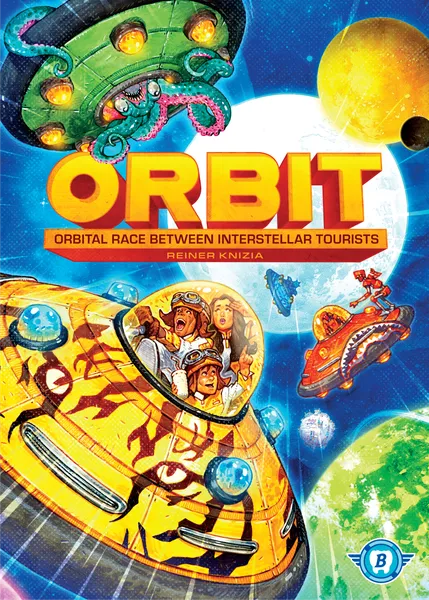
ORBIT
Official Description:
ORBIT is set in the 24th century, where galactic tourists race to visit all the planets of the Silo System. Players take on the roles of these interstellar travelers, each aiming to be the first to complete their journey across the system and return to their starting planet. The game combines tactical movement and strategic planning as players navigate the orbital paths of the planets.
Throughout the game, players use cards to control the movement of their spaceships, making decisions that affect both their own progress and that of their opponents. The challenge lies in optimizing routes and timing actions to outmaneuver rivals, all while adapting to the dynamic positions of the planets as they orbit.
ORBIT offers a blend of simple turns and challenging possibilities, making it accessible yet engaging for a wide range of players. The objective is clear: visit every planet in the system and return home before anyone else, making for a competitive and fast-paced space race experience.
ORBIT operates in the tradition of Knizia’s sharp, hand-management race games, but with a spatial twist: the board’s planetary orbits are in constant flux, demanding players adapt their plans on the fly. The one-card-per-turn rule enforces a tight tempo, keeping the table’s mental friction high as each decision must account for shifting opportunities and the unpredictable moves of rivals. This system delivers a top-tier strategic dividend—its high operational reliability is why it remains a regular fixture for groups seeking a tense, interactive puzzle that rewards both tactical timing and long-term route optimization.
From a logistics standpoint, ORBIT is refreshingly streamlined. The box contains only the essentials: a large player board, a handful of UFO miniatures, and a deck of movement cards. Setup is straightforward and fits comfortably within a quarter-hour, making it a practical choice for nights when you want a full-featured experience without a lengthy prep. With a 60-minute playtime, it’s best positioned as a main event for groups who appreciate a focused, competitive challenge that doesn’t overstay its welcome.
Teaching ORBIT is direct—players are up to speed by the second round, and the clear distinction between repeatable and one-time abilities minimizes confusion. The system’s light learning curve means you can introduce it to mixed-experience tables and still step away to manage other duties. The core skill dividend is in route planning and adaptive timing; players leave the table sharper for having navigated a board that constantly audits their spatial logic. The competitive interaction keeps the room engaged, with every turn carrying the potential to disrupt or outmaneuver, ensuring the energy stays high throughout the session.
Category
Tactical & Strategy
My score
8
Our Total Plays
4
Last PLayed
26 Dec 25
🔥 In Rotation
Player Count
2-4
Playtime
60 mins
Proficiency Perks
Strategic Planning
Systems & Logic
Check Amazon
As an Amazon Associate, I earn from qualifying purchases.
← ALL BOARD GAMe REVIEWS