New York Zoo
Official Description:
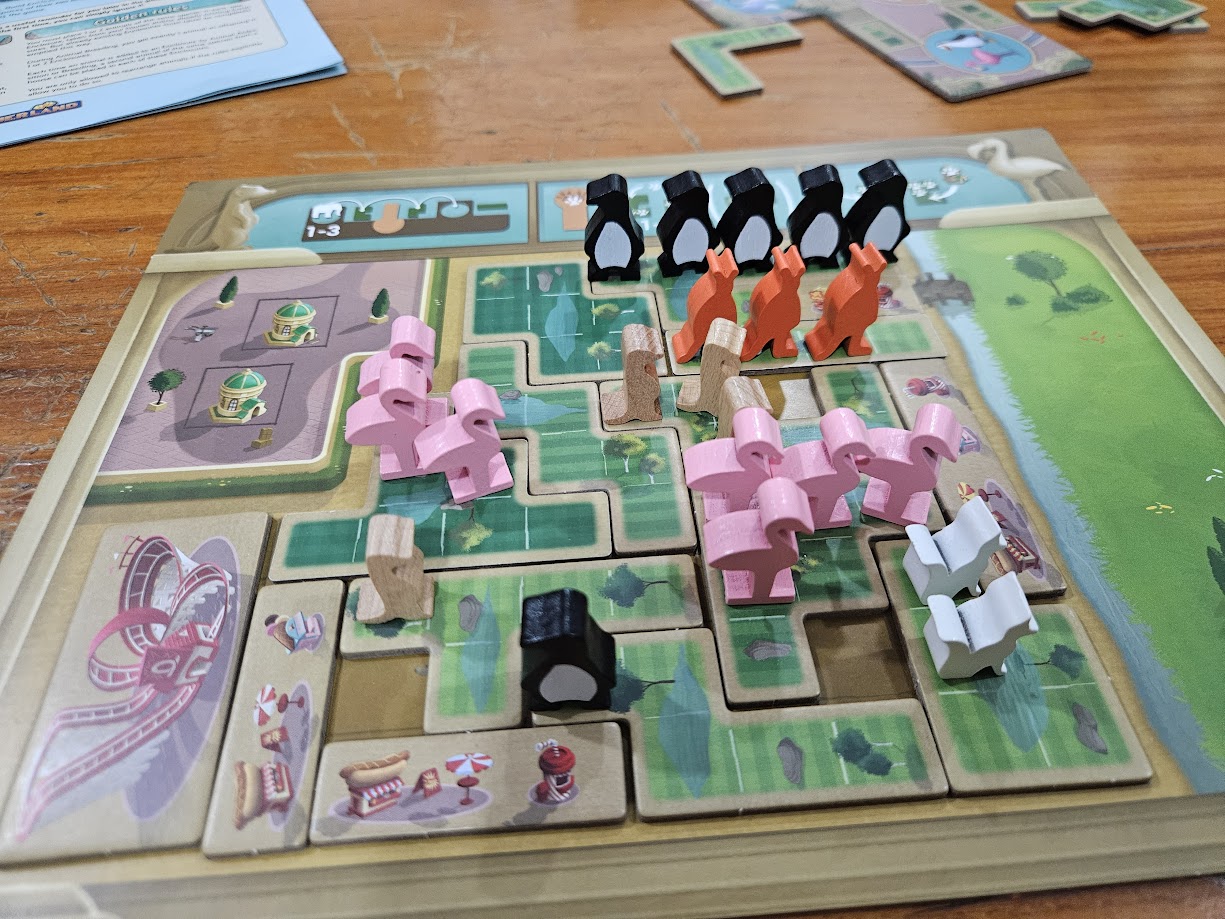
In New York Zoo, players take on the role of animal park builders, tasked with constructing enclosures, introducing new animals, and managing the breeding of their zoo’s inhabitants. The game is designed by Uwe Rosenberg and features a blend of tile placement and resource management mechanics. Each player must carefully plan the layout of their zoo, using polyomino tiles to cover their board efficiently while also ensuring the well-being and reproduction of their animals.
Throughout the game, players alternate between building enclosures and acquiring animals, with the goal of filling their zoo board as quickly and effectively as possible. Timing is crucial, as breeding phases allow players to multiply their animals, which can then be used to fill enclosures and score points. Strategic decisions about which tiles to take and when to breed animals are central to gameplay.
The winner is the first player to completely cover their zoo board with enclosures and attractions. New York Zoo offers a challenging puzzle experience, combining spatial reasoning with animal management in a competitive race to build the most successful zoo.
New York Zoo operates in the tradition of modular tile-layers, but with Rosenberg’s signature twist—animal management as a parallel puzzle layered atop spatial optimization. The core challenge is a sharp audit of your board coverage, where every polyomino placement must anticipate both enclosure needs and the timing of animal breeding. The system rewards forward planning: triggering breeding at the right moment and leveraging bonus moves for matching animal types can create a cascade of efficient turns. This blend of tactical tile selection and animal multiplication delivers high operational reliability, which is why it remains a regular fixture in collections that see frequent play. Its streamlined objective—filling your board rather than tallying complex points—keeps the pace brisk and the focus tight, making it a top-tier strategic dividend for curators who value games that consistently earn their table time.
Component-wise, the box contents are a study in both charm and caution. Premium wooden animal meeples add tactile appeal, but the thin player boards demand careful handling, especially during setup and teardown. With a typical session clocking in at about an hour and setup that fits comfortably within a quarter-hour, it’s well-suited as a main event for a focused group or a reliable anchor for a mid-length game night. The digital implementation on BGA offers a high-quality alternative for remote or asynchronous play, but the physical edition’s table presence is a draw for those who appreciate tangible components. For hosts, the game’s footprint and session length strike a practical balance—substantial enough to satisfy, but not so sprawling as to monopolize the evening.
From a teaching perspective, New York Zoo sits firmly in the procedural camp: expect a 20-minute rules brief, with particular emphasis on clarifying breeding triggers and the nuances of bonus actions. Once underway, the parallel play structure means players can largely manage their own turns, freeing the facilitator to observe or step away as needed. The system’s mental friction is rooted in spatial visualization and sequencing—players leave the table with a sharpened sense of how to optimize limited space under evolving constraints. Interaction is indirect, so the room’s energy stays focused and contemplative rather than combative, making it ideal for groups who prefer thoughtful competition over direct confrontation.
Category
Tactical & Strategy
My score
9
Our Total Plays
14
Last PLayed
16 Aug 25
🔥 In Rotation
Player Count
1-5
Playtime
60 mins
Proficiency Perks
Strategic Planning
Systems & Logic
Spatial Reasoning
👑 PREMIUM
Play on BGA
Check Amazon
As an Amazon Associate, I earn from qualifying purchases.


