Nasi Lemak: The Game
Official Description:
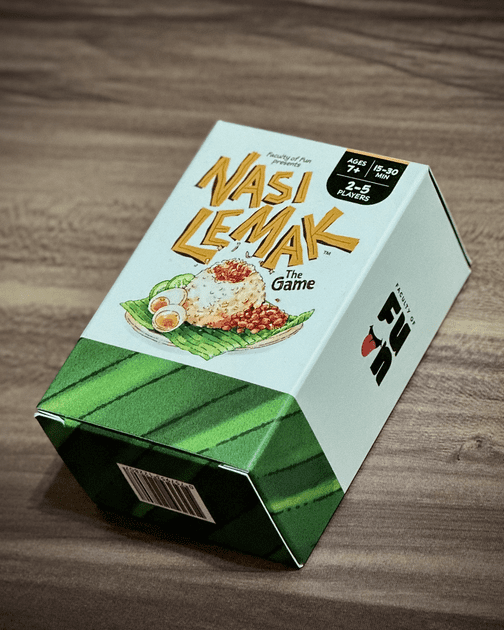
Nasi Lemak: The Game is a fun and competitive card game designed for 2 to 5 players, with a playtime of 15 to 30 minutes. Set in a far-away village where Nasi Lemak, a beloved Malaysian dish, is a staple, players take on the role of hawkers competing to serve the most delicious and complete Nasi Lemak packs to customers.
Throughout the game, players collect various ingredient cards such as rice, sambal, egg, peanuts, and anchovies, aiming to assemble complete Nasi Lemak sets. Special action cards introduce elements of strategy and interaction, allowing players to steal ingredients, block actions, or disrupt opponents’ plans.
The objective is to be the first to complete a set number of Nasi Lemak packs, balancing resource management and tactical play. The game captures the spirit of friendly rivalry and the cultural significance of Nasi Lemak, making it accessible and engaging for both casual and experienced gamers.
Nasi Lemak: The Game sits squarely in the tradition of quick-play, culturally themed card games—easy to deploy, easy to cycle, and designed for immediate engagement. Its set-collection mechanics are straightforward, with the Malaysian food theme providing a light narrative hook rather than deep mechanical innovation. The game’s selective deployment only is evident in its shelf performance: it’s a pleasant diversion for new groups or as a cultural curiosity, but it rarely earns repeat table time among seasoned players. For a collection of this size, its current value is as a fresh rotation piece for onboarding or as a conversation starter, not as a long-term anchor.
Component-wise, the box is compact and travel-friendly, with playful illustrations that help sell the theme at a glance. Setup is minimal—open the box, shuffle, and deal—making it a practical choice for filling short gaps between heavier games or as a warm-up. However, the card design does little to clarify gameplay at a glance, so expect to field basic questions about icons and objectives during the first play. It’s best positioned as a light opener or a quick cooldown, not as a main event or a session closer for experienced groups.
From a teaching perspective, the rules are accessible and the learning curve is gentle—players are usually comfortable by the second round. The main teaching hurdle is clarifying the unique powers tied to each character and ensuring everyone tracks their ingredient counts accurately. The game’s mental friction is low: players practice basic set recognition and opportunistic blocking, but there’s little depth beyond that. The competitive interaction keeps the table lively, but the stakes are low, so the energy stays friendly and light. Once the basics are covered, the system is stable enough for the host to step back and let the table run itself.
Category
Casual & Filler
My score
5.5
Our Total Plays
2
Last PLayed
20 Jun 26
🌱 Breaking In
Player Count
2-5
Playtime
30 mins
Proficiency Perks
Systems & Logic
Check Amazon
As an Amazon Associate, I earn from qualifying purchases.
← ALL BOARD GAMe REVIEWS