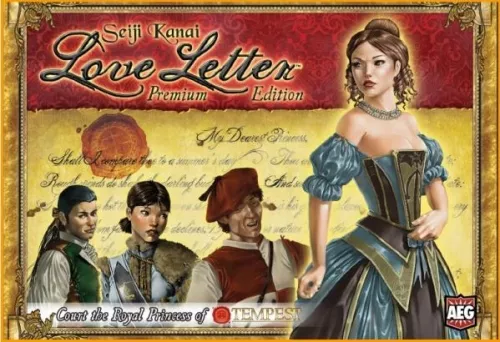
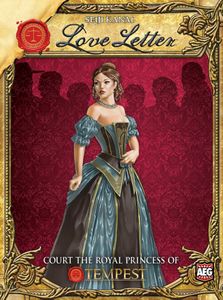
Love Letter
Official Description:
Love Letter is a game of risk, deduction, and luck for 2–4 players. The game consists of a deck with only sixteen cards, and each player starts with one card in hand. On a turn, a player draws one card and plays one of the two cards in their hand, applying its effect. The goal is to get your love letter delivered to the princess while deflecting the letters from competing suitors.
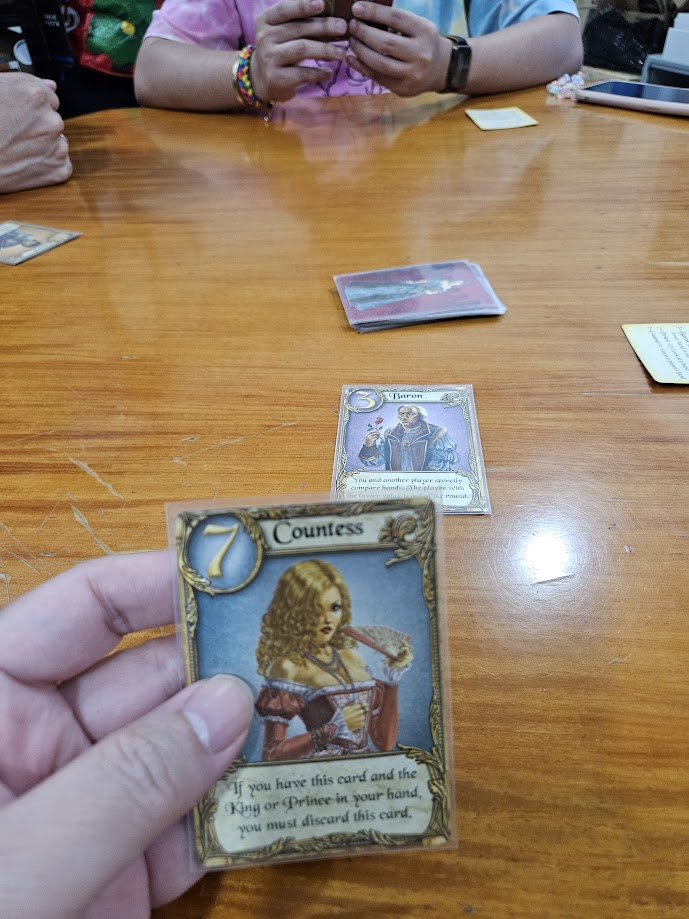
Each card in the deck represents someone close to the princess, such as the guard, priest, baron, handmaid, prince, king, countess, or princess herself. Each character has a unique effect, and players must use deduction and strategy to outwit their opponents. The round ends when the deck is empty or all but one player is eliminated; the player with the highest-value card wins the round and earns a token of affection.
The game is played over several rounds, and the first player to win a set number of tokens wins the game. Love Letter is known for its simple rules, quick playtime, and engaging gameplay, making it a popular choice for both new and experienced gamers.
Sixteen cards, one core loop: draw, play, resolve. Love Letter distills competitive deduction into a format that’s both physically minimal and strategically dense. As a modern descendant of the social deduction lineage, it leverages direct player interaction and bluffing, rewarding sharp reads and calculated risk. Its high operational reliability is evident in how often it hits the table—nearly every session, it’s requested or deployed, a testament to its significant long-term shelf retention. The game’s current momentum is no accident; its ability to generate tension and laughter in under 20 minutes keeps it at the forefront of any veteran’s portable arsenal.
From a logistics standpoint, Love Letter is the definition of efficiency. The entire experience is contained in a handful of cards and a few tokens, making setup and teardown nearly instantaneous. This compactness translates to maximum flexibility: it’s the ideal solution for filling gaps between heavier games, warming up a group, or salvaging a session when time is tight. There’s no table sprawl, no component management, and no risk of downtime—just open the box and play. For hosts managing multiple tables or events, its high satisfaction-to-size ratio ensures it’s always worth packing.
Teaching Love Letter is a low-friction affair. The rules are absorbed by the second round, and the only recurring clarifications—such as the Guard’s targeting restriction or the Prince’s self-target—are quickly internalized. The system’s competitive nature keeps everyone engaged, and the mental friction comes from reading opponents and managing imperfect information, not from procedural overhead. This means a facilitator can step away after the teach, confident the table will self-regulate. The game’s interaction profile keeps the energy high, with each play sparking table talk, speculation, and the kind of memorable moments that anchor it as a perennial favorite.
Category
Social & Party
My score
8
Our Total Plays
30
Last PLayed
23 Jan 26
🔥 In Rotation
Player Count
2-4
Playtime
20 mins
Proficiency Perks
Social Meta
👑 PREMIUM
Play on BGA
Check Amazon
As an Amazon Associate, I earn from qualifying purchases.
← ALL BOARD GAMe REVIEWS