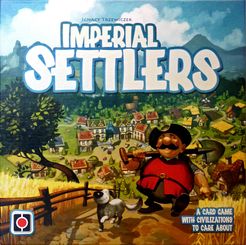
Imperial Settlers
Official Description:
Imperial Settlers is a card game in which players lead one of four factions—Romans, Barbarians, Egyptians, or Japanese—each seeking to build and expand their own empire. Players achieve this by constructing buildings, gathering resources, and managing workers, all represented by cards and tokens. The game emphasizes strategic planning as players must decide how to use their resources each round, balancing expansion with defense and production.
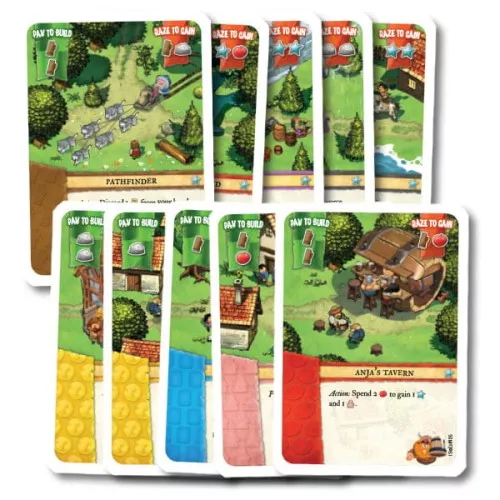
Each faction has its own unique deck and abilities, providing distinct playstyles and strategies. Players use their cards to develop their empire, create production chains, and interact with other players, sometimes through direct conflict or by hindering opponents’ progress. The game is played over five rounds, with each round consisting of phases for drawing cards, producing resources, taking actions, and resolving conflicts.
Victory is determined by the number of victory points earned through building structures, completing objectives, and managing resources efficiently. Imperial Settlers combines engine-building mechanics with tactical decision-making, offering replayability through asymmetric factions and multiple paths to victory.
Imperial Settlers operates as a high-caliber engine-builder, drawing on the tactical DNA of modular card-driven systems and asymmetric faction play. Its lineage is clear: a direct evolution from 51st State, but with a sharper focus on civilization-specific drafting and resource optimization. The game’s high operational reliability is evident in its ability to reward players who thrive on tight, efficient loops—each faction’s unique deck and abilities create a dynamic puzzle that remains fresh even after repeated sessions. Its current shelf presence is justified; after years of managing tables, I can confirm that few titles maintain this level of strategic dividend while still feeling approachable. The game’s ongoing rotation is a testament to its significant long-term shelf retention, especially for groups that appreciate a blend of tactical aggression and clever resource cycling.
From a logistics standpoint, Imperial Settlers is refreshingly straightforward: a compact box with just enough space for expansions, and components that are easy to inventory between sessions. Setup is direct, but the play area expands quickly as empires grow, so plan for a full table if you’re running with four. Ninjas—those elusive cards—can be overlooked, so double-check the decks before play. With a 90-minute session time, it’s best positioned as the main event for the evening, not a filler. The physical footprint and the need for clear player areas mean it’s not ideal for cramped spaces, but the streamlined component load makes teardown painless.
Teaching Imperial Settlers is a procedural affair—expect a 20-minute rules brief, especially if you want to clarify the three-step card timing and faction-specific nuances. The system’s mental friction is moderate: players must juggle production, features, and actions each round, and the Razing mechanic introduces a layer of direct competition that keeps the table alert. Once the first round is underway, most groups can self-manage, but new players benefit from reminders about faction strengths and the timing of key actions. The competitive interaction level ensures the room stays engaged, with enough tactical interplay to keep even seasoned hosts invested. The skill dividend here is substantial: players leave with a sharper sense of timing, resource sequencing, and adaptive planning—qualities that translate well to other engine-builders in the collection.
Category
Tactical & Strategy
My score
9
Our Total Plays
35
Last PLayed
24 Aug 25
🏛️ Legacy
Player Count
1-4
Playtime
90 mins
Proficiency Perks
Strategic Planning
Systems & Logic
👑 PREMIUM
Play on BGA
Check Amazon
As an Amazon Associate, I earn from qualifying purchases.
← ALL BOARD GAMe REVIEWS