
EXIT: The Game – The Venice Conspiracy
Official Description:
EXIT: The Game – The Venice Conspiracy is a puzzle game inspired by real-life escape rooms. Players take on the role of members of the Italian secret service, tasked with unraveling a mysterious conspiracy threatening the city of Venice. The game challenges participants to solve a series of interconnected riddles and puzzles, using clues and components provided in the box.
The gameplay is designed to be immersive and interactive, requiring players to fold, write on, or tear certain materials as they progress through the story. This single-use format ensures that each session is unique and that players must work collaboratively to uncover the secrets behind the conspiracy. The narrative unfolds as players advance, with each solved puzzle bringing them closer to saving Venice from impending danger.
EXIT: The Game – The Venice Conspiracy is suitable for solo or cooperative play, typically accommodating up to four players. The experience is intended to be both challenging and engaging, offering a blend of logical reasoning, teamwork, and creative problem-solving as players race against time to thwart the plot against Venice.
EXIT: The Game – The Venice Conspiracy positions itself within the established tradition of atmospheric, narrative-driven escape room experiences, this time leveraging the intrigue of a Venetian masquerade and the familiar puzzle cadence of the Exit system. The game’s structure leans into a more challenging puzzle set than the series’ entry-level offerings, with a difficulty curve that occasionally veers into non-intuitive logic. The narrative unfolds through a series of interconnected riddles, requiring players to manipulate the box contents—folding, writing, and tearing as the story demands. For a collection already deep in one-time-play titles, its solid table-time value comes from the blend of immersive theme and a standout endgame puzzle, though the overall mix is less balanced than the best in the line. As a solved title, its shelf retention is limited; it serves more as a reference point for future curation or as a hand-me-down for new groups.
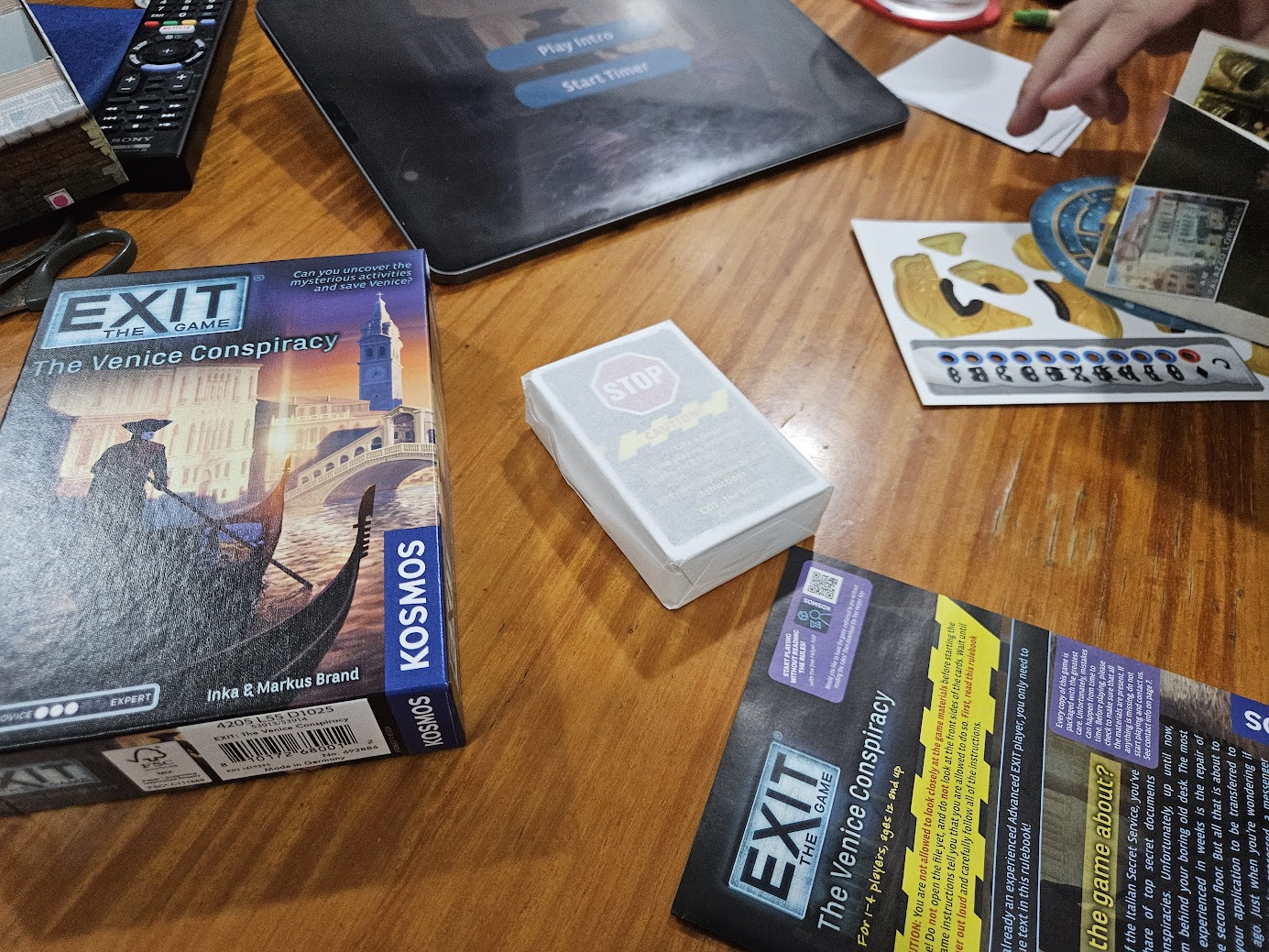
From a logistics standpoint, the game arrives in a standard box with a few bonus items, following the familiar single-use, consumable format of the Exit series. Setup is minimal—open the box, distribute the components, and you’re ready to begin—making it a practical choice for hosts seeking a low-prep, 90-minute session. The consumable nature means it’s not a repeatable staple, but it fits well as a main event for a focused group or as a special feature in a puzzle-themed night. The physical management is straightforward, with no elaborate boards or trays to manage, but hosts should be prepared for the irreversible nature of the components.
Teaching the system is direct: the rules are accessible, and most groups will be comfortable by the second puzzle. The collaborative structure keeps everyone engaged, with the mental friction coming from lateral thinking and group deduction rather than procedural complexity. The game’s design encourages shared problem-solving, so the facilitator can step back and let the table drive the experience. The skill dividend here is a sharpened sense of creative reasoning and group communication, though the occasional leap in logic may frustrate less patient players. The cooperative dynamic keeps the room’s energy high, especially as the narrative tension builds toward the final reveal.
Category
Thematic & Narrative
My score
7
Our Total Plays
1
Last PLayed
16 Feb 26
🔍 Solved
Player Count
1-4
Playtime
90 mins
Proficiency Perks
Systems & Logic
Check Amazon
As an Amazon Associate, I earn from qualifying purchases.
← ALL BOARD GAMe REVIEWS