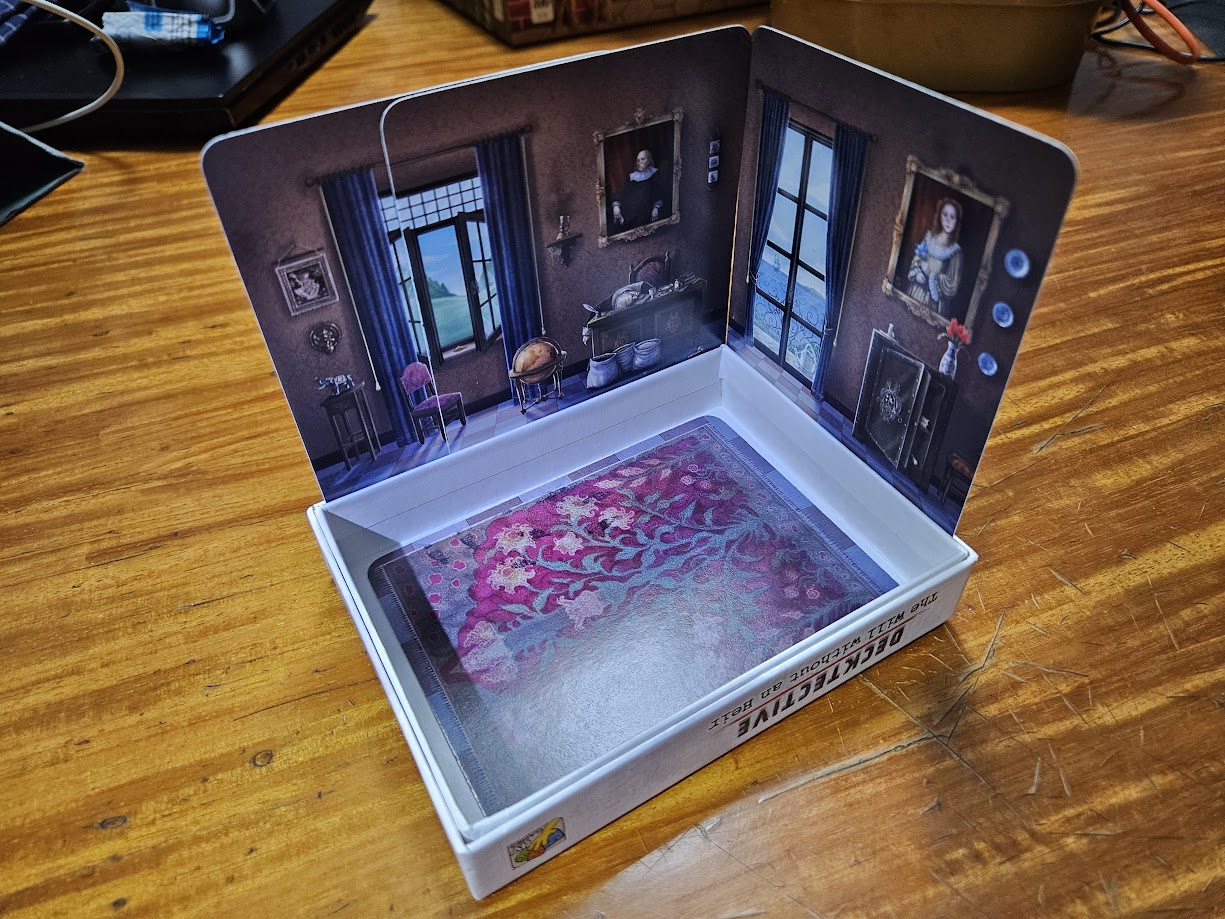

Decktective: The Will without an Heir
Official Description:
Decktective: The Will without an Heir is a cooperative investigation game that immerses players in a mysterious case set in the 17th century. The game features a unique 3D crime scene, which players construct using the game components to visualize and analyze the evidence. Working together, players must examine clues, discuss theories, and piece together the sequence of events to solve the case.
The narrative centers around a murder connected to the Dutch East India Company in 1698. Players take on the roles of investigators, exploring the circumstances surrounding the death and the mysterious will left behind. Throughout the game, they will encounter various suspects, motives, and hidden secrets, all of which must be carefully considered to uncover the truth.
As the investigation unfolds, players must decide which clues to share and which to keep secret, balancing cooperation with strategic decision-making. The goal is to reconstruct the events, identify the culprit, and understand the motive behind the crime. Decktective: The Will without an Heir offers an engaging and immersive experience, challenging players’ deductive reasoning and teamwork skills.
Decktective: The Will without an Heir operates as a compact, cooperative investigation set in the late 17th century, leveraging a clever 3D crime scene built directly from the box contents. The narrative—rooted in Dutch East India Company intrigue—anchors the experience in a lineage of historical deduction games, but with a tactile twist: the box lid becomes the stage for evidence, and the card-driven system demands careful sequencing of clues and interviews. The game’s solid table-time value comes from its ability to deliver a focused, immersive micro-investigation in a single session, making it a reliable secondary option for curators who value thematic punch and resettable design. Now that the case is solved, its replay value is limited, but it remains a strong candidate for lending or introducing to new groups, especially for those who appreciate a self-contained mystery with a few clever mechanical pivots.
From a logistics standpoint, this title is a model of efficiency. The pocket-sized box contains everything needed for setup, with the lid doubling as the crime scene display—no sprawling boards or fiddly components to manage. Setup is nearly instantaneous, and the game’s fully resettable nature means it can be passed along or replayed with a fresh group. With a 60-minute session time, it fits neatly as a main event for a smaller gathering or as a focused closer after a heavier game. The physical footprint is minimal, and the scene-building element adds a touch of spectacle without complicating the flow, making it ideal for hosts who want a memorable experience without logistical overhead.
Teaching Decktective: The Will without an Heir is straightforward—players are comfortable by the second round, and the collaborative structure means the facilitator can step back once the basics are covered. The main teaching point is managing the card economy: deciding when to reveal clues versus archiving them, and clarifying the interview mechanic as it arises. The system’s mental friction is moderate, rewarding players who can synthesize narrative threads and evidence under time pressure. The pure collaborative format keeps the room engaged, with discussion and theory-crafting driving the energy. Players leave with a tangible skill dividend in deductive reasoning and group problem-solving, making it a satisfying, low-barrier entry for both seasoned investigators and newcomers.
Category
Thematic & Narrative
My score
7
Our Total Plays
1
Last PLayed
15 Mar 24
🔍 Solved
Player Count
1-6
Playtime
60 mins
Proficiency Perks
Systems & Logic
Check Amazon
As an Amazon Associate, I earn from qualifying purchases.
← ALL BOARD GAMe REVIEWS


