
Crime Zoom: His Last Card
Official Description:
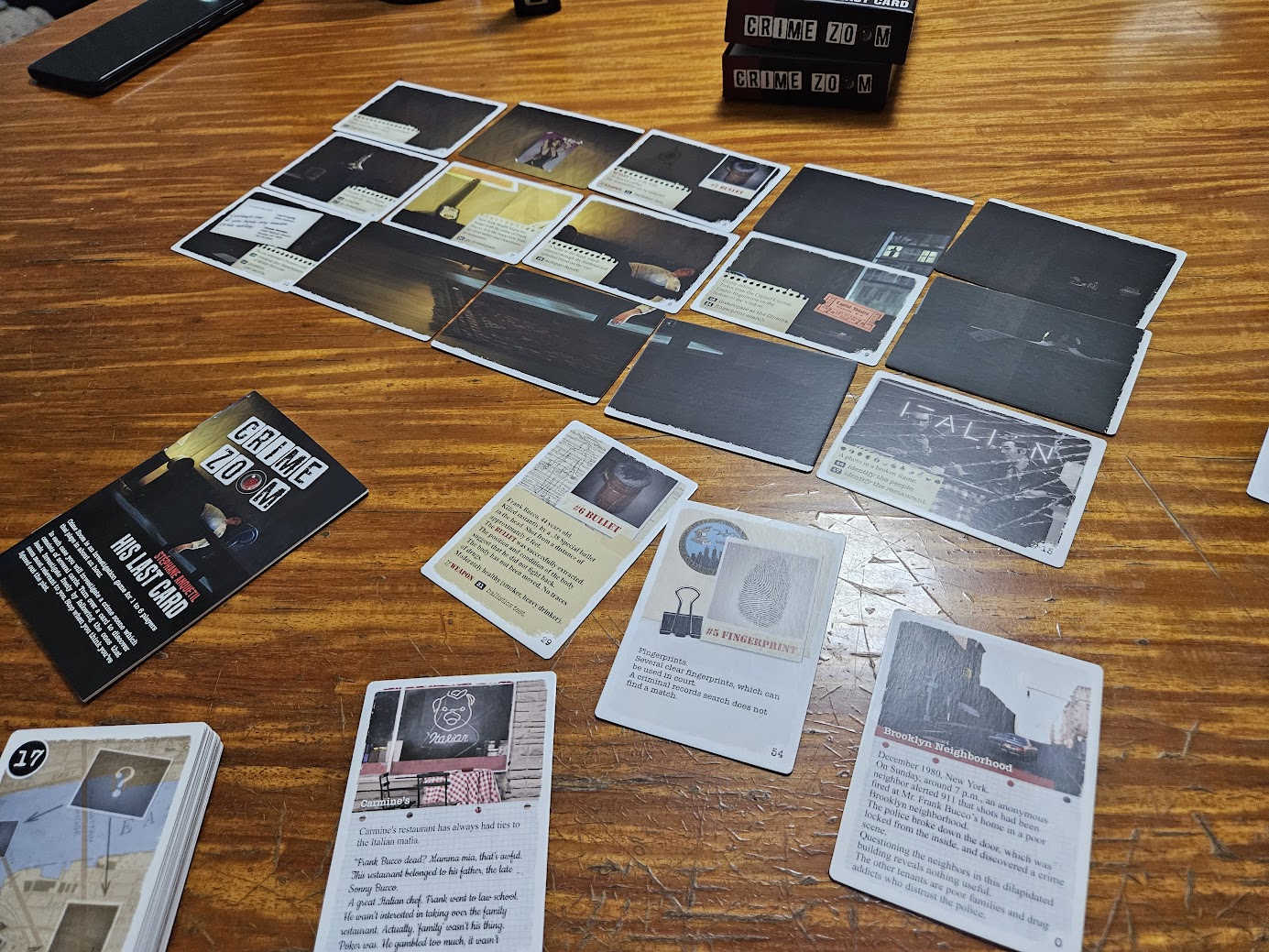
Crime Zoom: His Last Card is a cooperative investigation game designed for 1 or more players, with each session lasting about an hour. The game begins with an illustrated crime scene composed of several cards. Players flip over these cards to examine different parts of the scene, uncovering clues and leads that they can choose to follow as they attempt to solve the mystery.
Throughout the investigation, players must decide which leads to pursue, piecing together evidence and information to reconstruct the events surrounding the crime. The game encourages discussion and deduction, as players work together to interpret the clues and determine the sequence of events, the motives, and the identity of the perpetrator.
Each Crime Zoom game presents a unique story and mystery to solve, offering replayability and variety. The objective is to answer key questions about the case by the end of the investigation, using the clues gathered to provide a coherent and accurate account of what happened.
Crime Zoom: His Last Card opens with a visually dense tableau, immediately immersing players in a dramatic investigation. The game’s narrative roots are clear—this is a modern entry in the card-driven deduction lineage, where the physical act of flipping cards mirrors the process of uncovering evidence. The initial momentum is strong, with the crime scene’s layout providing a high-impact entry point for group discussion. However, the experience settles into a pattern of selective deployment only; the puzzle quality varies, and some logic leaps can stall progress, making it a title best reserved for those who appreciate the genre’s quirks rather than expecting consistent mechanical performance. Its current value to a veteran curator is as a solved case: a compact, thematic curiosity that’s unlikely to see repeat play once the mystery is unraveled.
From a logistics standpoint, the ultra-compact box and minimal table footprint make this an ideal candidate for portable deduction sessions—think travel, conventions, or as a quick diversion between heavier games. Setup is nearly instantaneous; the box contents are all you need, and the session wraps in about an hour. This makes it a practical option for filling a gap in a game night or as a low-commitment opener. There’s no component sprawl or lengthy teardown, so it won’t disrupt the flow of a multi-table event or casual gathering.
Teaching Crime Zoom: His Last Card is straightforward—most groups will be comfortable by the second turn, and the collaborative structure means the facilitator can step back and let the table drive the investigation. The main skill dividend is in group deduction and collective reasoning, as players sift through clues and debate interpretations. The pure collaborative format keeps the energy focused and inclusive, but the occasional lack of intuitive logic paths can lead to moments of collective frustration. For hosts, it’s a low-prep, low-maintenance title that delivers a focused, if sometimes uneven, deduction experience.
Category
Thematic & Narrative
My score
6
Our Total Plays
1
Last PLayed
30 Jul 23
🔍 Solved
Player Count
1-6
Playtime
60 mins
Proficiency Perks
Systems & Logic
Check Amazon
As an Amazon Associate, I earn from qualifying purchases.
← ALL BOARD GAMe REVIEWS