
Azul
Official Description:
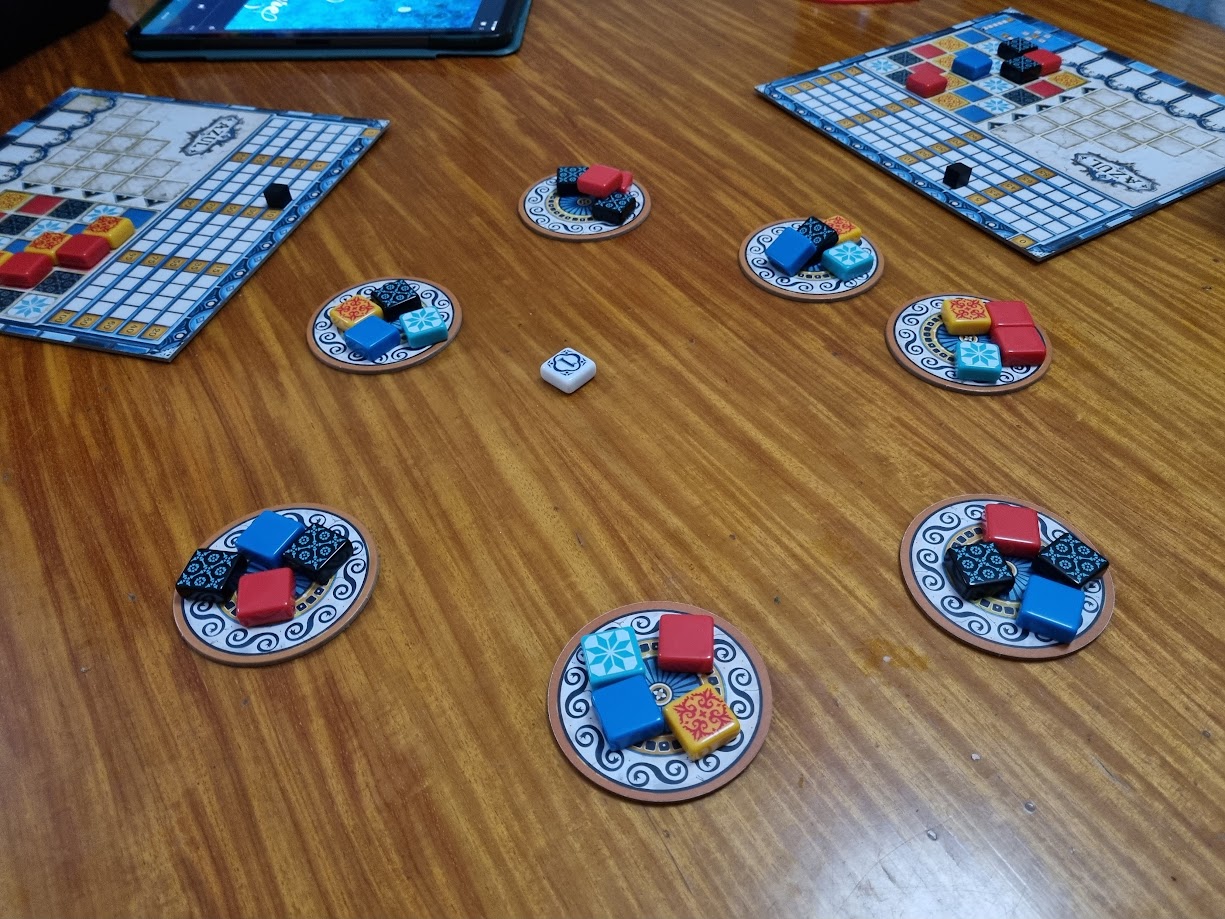
Azul is a tile-drafting game in which players take turns selecting colored tiles from suppliers to place onto their player board. The goal is to complete specific patterns and sets, earning points based on how tiles are arranged and the completion of rows, columns, and color sets. Players must carefully choose tiles to maximize their score while also potentially disrupting their opponents’ plans.
The game is inspired by the decorative azulejos, the Moorish ceramic tiles introduced by the Portuguese king Manuel I. Players compete to embellish the walls of the Royal Palace of Evora, balancing aesthetic design with strategic placement. Each round, players draft tiles, place them in specific patterns, and score points, with penalties for wasted tiles.
Azul is known for its elegant mechanics, beautiful components, and accessible yet deep gameplay. It challenges players to think ahead, adapt to changing circumstances, and outmaneuver their opponents, making it a highly regarded modern board game.
Azul operates as a modern abstract anchored in the tradition of tactical drafting and spatial optimization, but it distinguishes itself with a physicality that’s both inviting and ruthless. The resin tiles deliver a satisfying tactile feedback, masking the underlying cutthroat nature of the draft—every selection is a defensive maneuver as much as a step toward your own mosaic. The system’s mental friction is sharp: players must visualize not just their own board’s evolving patterns but also anticipate and disrupt opponents’ plans. The penalty for overreaching—the Floor Line—teaches efficiency early, and the scoring cadence rewards those who can pivot under pressure. Its significant long-term shelf retention is no accident; despite a wave of sequels, the original remains the definitive version, and its current table presence reflects a top-tier strategic dividend for any collection.
From a logistics standpoint, Azul is a paradox: the box is generous, the insert stubborn, and expansion storage is a non-starter unless you’re ready to reconfigure. Player boards, however, justify the table footprint, and the 45-minute session time makes it a reliable anchor for a game night—substantial enough to serve as a main event, but not so sprawling that it derails the evening’s flow. Setup and teardown are straightforward, but the physical sprawl means you’ll want a dedicated table and a willingness to manage components between rounds.
Teaching Azul is a procedural affair—expect to guide scoring for several rounds, especially as new players internalize the consequences of wasted tiles. The competitive tension is ever-present, and the system’s skill dividend is clear: players leave with a sharper sense of pattern recognition and adaptive planning, as the board performs a constant audit of their spatial visualization. The indirect interaction keeps the room engaged, with energy levels rising as players jockey for position and block each other’s optimal moves. Once the basics are absorbed, the game runs itself, allowing the host to step back and watch the table’s dynamics unfold.
Category
Tactical & Strategy
My score
10
Our Total Plays
34
Last PLayed
03 Jan 26
🔥 In Rotation
Player Count
2-4
Playtime
45 mins
Proficiency Perks
Strategic Planning
Spatial Reasoning
👑 PREMIUM
Play on BGA
Check Amazon
As an Amazon Associate, I earn from qualifying purchases.
← ALL BOARD GAMe REVIEWS