
A Fake Artist Goes to New York
Official Description:
A Fake Artist Goes to New York is a party game for 5–10 players that blends creativity with social deduction. In each round, one player acts as the Question Master, who selects a category and writes a specific word related to that category on cards for all players except one. The player who receives a blank card is the "fake artist" and does not know the secret word.
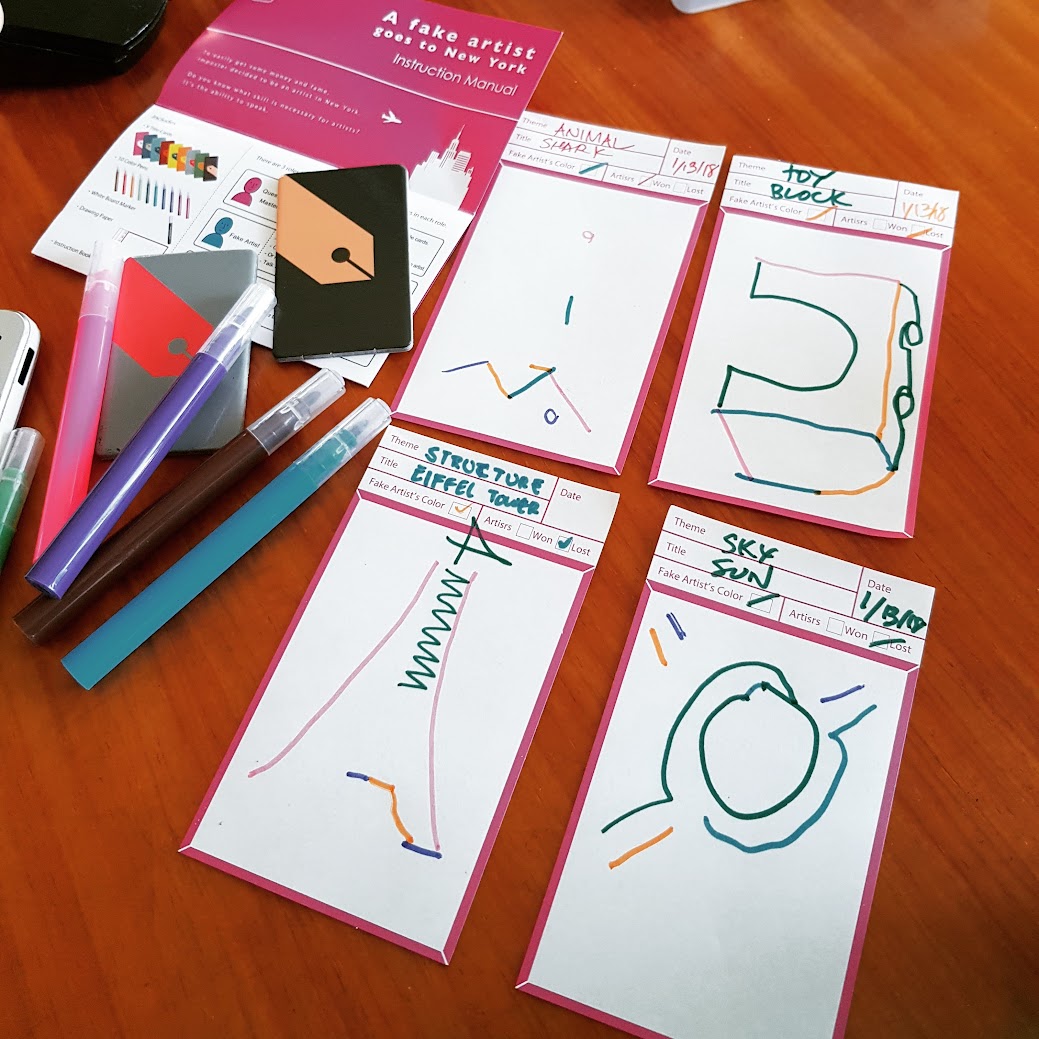
Players then take turns drawing a single line to collectively create a picture that represents the secret word. The challenge for the fake artist is to blend in and avoid detection, while the other players try to identify who among them is the impostor. After everyone has contributed to the drawing, players discuss and vote on who they believe the fake artist is.
If the fake artist is caught, they have one chance to guess the secret word to claim victory. The game encourages both bluffing and deduction, making it a unique and engaging experience for groups seeking a creative party game.
A Fake Artist Goes to New York stands as a modern descendant of the social deduction party lineage, but with a creative twist that leverages both bluffing and artistic improvisation. The core tension—one player secretly lacking the prompt while everyone else tries to expose them—generates a unique blend of mental friction and laughter. Its consistent mechanical performance over years of managing tables is no accident: the game’s structure rewards both quick wit and subtle observation, making it a reliable secondary option for groups who want more than just guessing and finger-pointing. Its continued presence in collections reflects significant long-term shelf retention, especially among hosts who value games that transcend their minimal components.
From a logistics standpoint, the signature Oink Games box is a model of efficiency—compact, instantly deployable, and containing only what’s needed: colored markers, a drawing pad, and prompt cards. Setup is nearly instantaneous, making it ideal for filling gaps between heavier games or as a spontaneous opener when the group is still assembling. The physical footprint is minimal, and the session time rarely exceeds 20 minutes, so it never overstays its welcome or disrupts the flow of a multi-table event. For curators and hosts, this is a title that can be deployed at a moment’s notice, with no risk of bogging down the schedule.
Teaching A Fake Artist Goes to New York is straightforward—most groups are comfortable by the end of the first round, and the collaborative drawing mechanic keeps everyone engaged. The system’s light learning curve means the facilitator can step back almost immediately, allowing the table’s energy to build organically as players debate, bluff, and deduce. The skill dividend here is twofold: players sharpen their ability to read social cues while also practicing concise visual communication. The high interaction level ensures the room stays lively, with each round delivering a fresh mix of tension and humor that’s hard to replicate with more procedural party games.
Category
Social & Party
My score
7
Our Total Plays
12
Last PLayed
12 Jan 18
🏛️ Legacy
Player Count
5-10
Playtime
20 mins
Proficiency Perks
Social Meta
Check Amazon
As an Amazon Associate, I earn from qualifying purchases.
← ALL BOARD GAMe REVIEWS